
Oil Condition Monitoring System: What It Includes and Why It Matters
What is an oil condition monitoring system?
An oil condition monitoring system is an integrated solution that continuously tracks the condition of lubricating oil in industrial equipment. It combines hardware, software and connectivity to give maintenance teams a real-time view of oil health — without manual sampling or laboratory turnaround times.
The system does not replace oil analysis. It extends it. Where laboratory analysis provides a periodic deep diagnostic, an oil condition monitoring system provides the continuous signal layer that sits between sampling intervals — detecting changes the moment they happen.
What a complete system includes
A fully functional oil condition monitoring system has four core components that work together (Picture 1.).
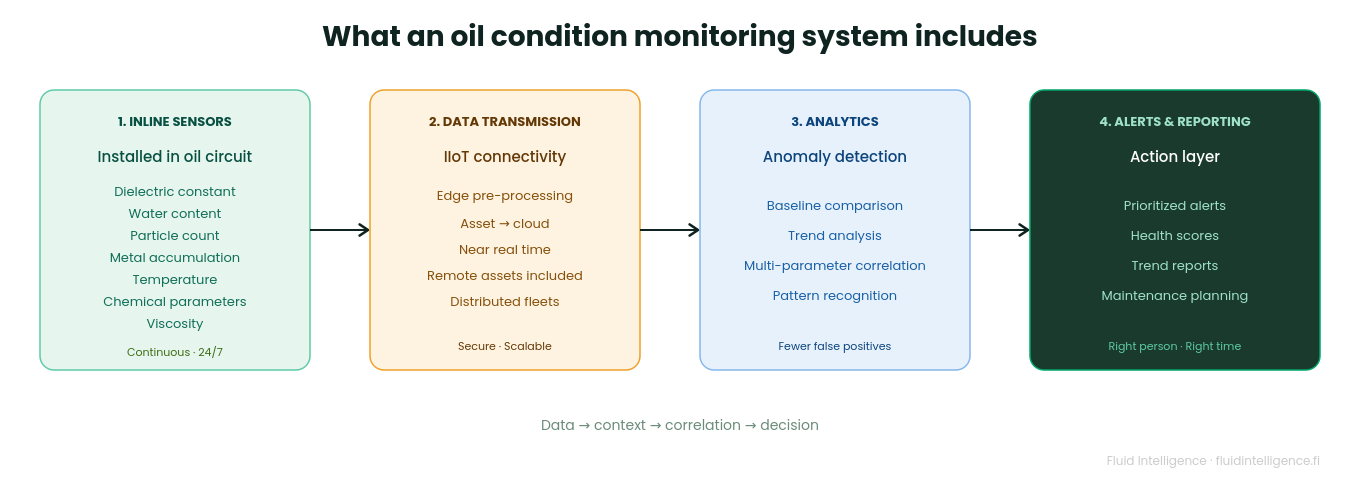
Picture 1. A complete oil condition monitoring system connects four layers — from continuous inline sensor measurement to prioritized alerts and maintenance reporting.
1. Inline sensors
Sensors are installed directly in the oil circuit — in the reservoir, gearbox, hydraulic line, or lubrication system. They measure parameters continuously: dielectric constant, water content, particle concentration, metal accumulation, viscosity, temperature, and chemical parameters among others. The sensors run without interruption, generating a continuous stream of oil condition data.
Learn more about the different types of oil monitoring sensors and what they measure→
2. Data acquisition and transmission
Raw sensor signals are collected, processed and transmitted to a central platform. In modern systems this happens via IIoT connectivity — data moves from the asset to the cloud in near real time, regardless of where the equipment is located. Remote assets, offshore installations, and distributed fleets are all reachable within the same system.
3. Analytics and anomaly detection
The platform processes incoming data against baseline profiles and defined thresholds. It identifies trends, detects anomalies, and correlates signals across parameters. A single sensor reading can be ambiguous — a rise in particle count could be contamination or a measurement artifact. Multi-parameter correlation reduces false positives and increases diagnostic confidence.
4. Alerts and reporting
When the system detects a condition outside normal range, it generates an alert. Alerts are prioritized by severity and routed to the right person — maintenance engineer, reliability manager, or operations team. The system also produces reports: trend summaries, health scores, and condition histories that feed into maintenance planning and documentation.
Why the system matters — not just the sensors
Individual sensors have value. A system has a different order of magnitude of value.
A single particle counter tells you the cleanliness level right now. An oil condition monitoring system tells you that particle counts have been rising steadily for nine days, that metal accumulation started increasing at the same time, that the dielectric constant shifted three days ago, and that this combination of signals points to early-stage bearing wear in a specific part of the circuit — and it sends that analysis to you before the shift starts.
The difference is not the sensor. It is the context, correlation and continuity that the system provides.
This is why leading industrial operators — in energy, mining, process manufacturing, and logistics — are moving from standalone measurements to integrated monitoring systems. The goal is not more data. It is earlier, more reliable decisions.
Where oil condition monitoring systems are deployed
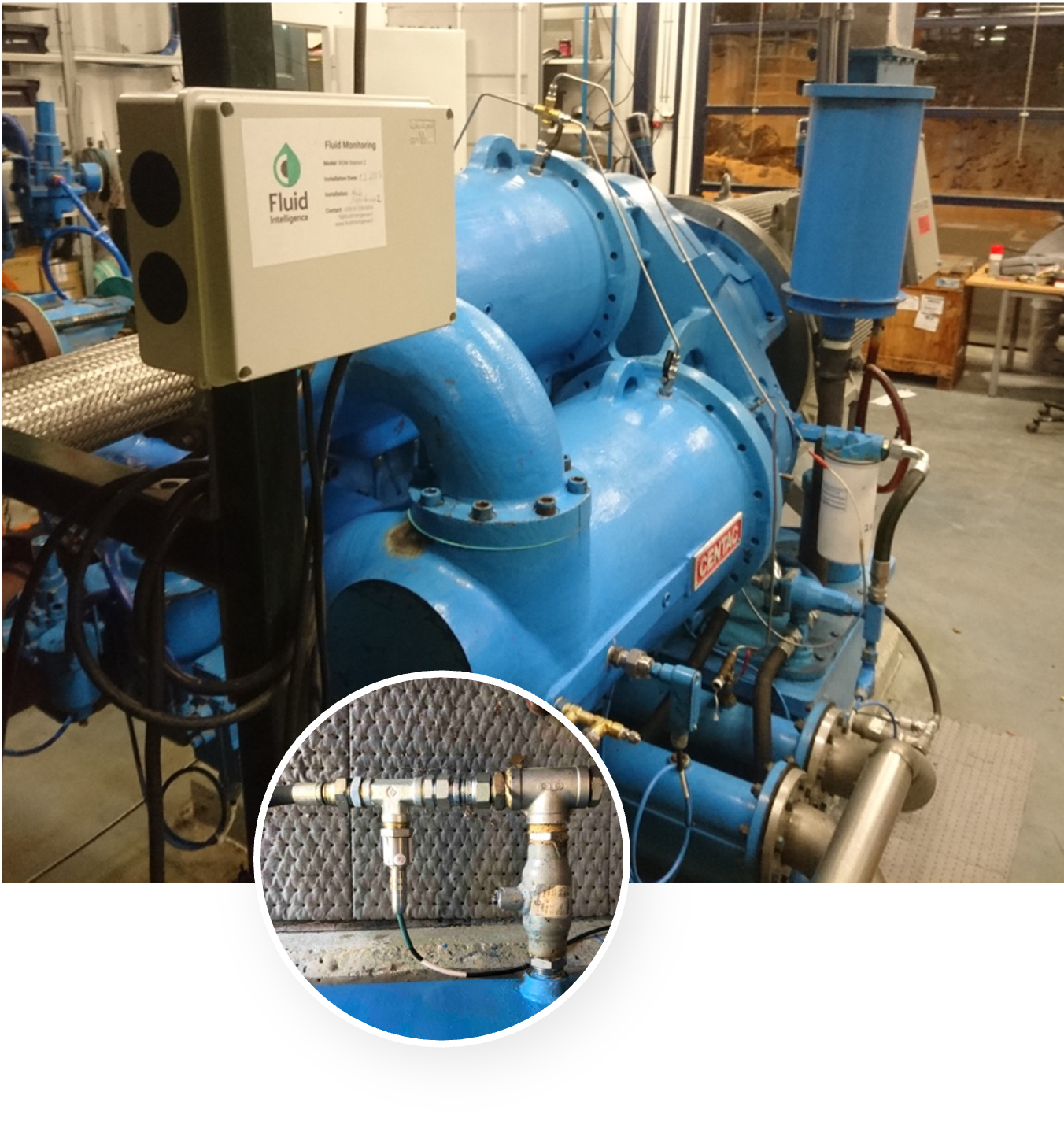
Picture 2. An oil condition monitoring sensor and EDGE-unit connected to a compressor
Oil condition monitoring systems are used wherever lubricant failure carries significant operational or financial risk.
Common deployment environments include (Picture 2.) hydraulic systems, industrial gearboxes, compressors, large engines and turbines, transformer oil systems, and process equipment running extended drain intervals. They are especially valuable in assets that are difficult to access for manual inspection — remote installations, offshore platforms, and distributed fleets where travel time alone makes reactive maintenance costly.
From system to strategy
An oil condition monitoring system is most effective when it is part of a broader fluid lifecycle strategy rather than a standalone tool.
The strongest maintenance programs connect three layers: real-time monitoring for continuous protection, laboratory analysis for deep diagnostics and verification, and optimization actions — filtration, additive correction, drain interval adjustment — based on what both data sources reveal.
When these layers work together, the result is a maintenance approach that is proactive rather than reactive, evidence-based rather than schedule-based, and continuously improving rather than static.
Next steps
Explore Connected Oil® - a real-time oil condition monitoring →
Learn about oil monitoring sensor types →
Oil analysis vs real-time monitoring: key differences →
Related Solutions from Fluid Intelligence
Connected Oil® Monitoring — for real-time visibility, anomaly detection and operational alerts.
Lab & Oil Data Manager — for structured lab data, health scoring, benchmarking and reporting.
Lube Optimization — for filtration, additive restoration and expert actions that extend oil life and improve reliability.
Want to see oil condition monitoring in practice?
Fluid Intelligence helps industrial teams connect monitoring, diagnostics and optimization into one lubrication lifecycle approach.