
3-blog series introduction
Reliability Without Waste: Rethinking Maintenance, Lubrication, and Data-Driven Decision-Making
By Eero Juustila, CTO
Industrial maintenance is undergoing a quiet transformation.
For decades, reliability was managed through schedules. Lubricants were replaced at predefined intervals, inspections were periodic, and decisions were guided by experience and safety margins.
Today, the challenge is different.
We can monitor assets continuously, we can measure lubricant condition in real time, and we can validate findings through laboratory diagnostics. Yet despite the availability of data, many organizations still struggle to convert signals and reports into consistent, actionable decisions.
At the same time, the pressure to reduce emissions, optimize resource use, and improve asset efficiency has never been higher.
Reliability and sustainability are no longer separate conversations. They are connected by one central factor: Decision quality.
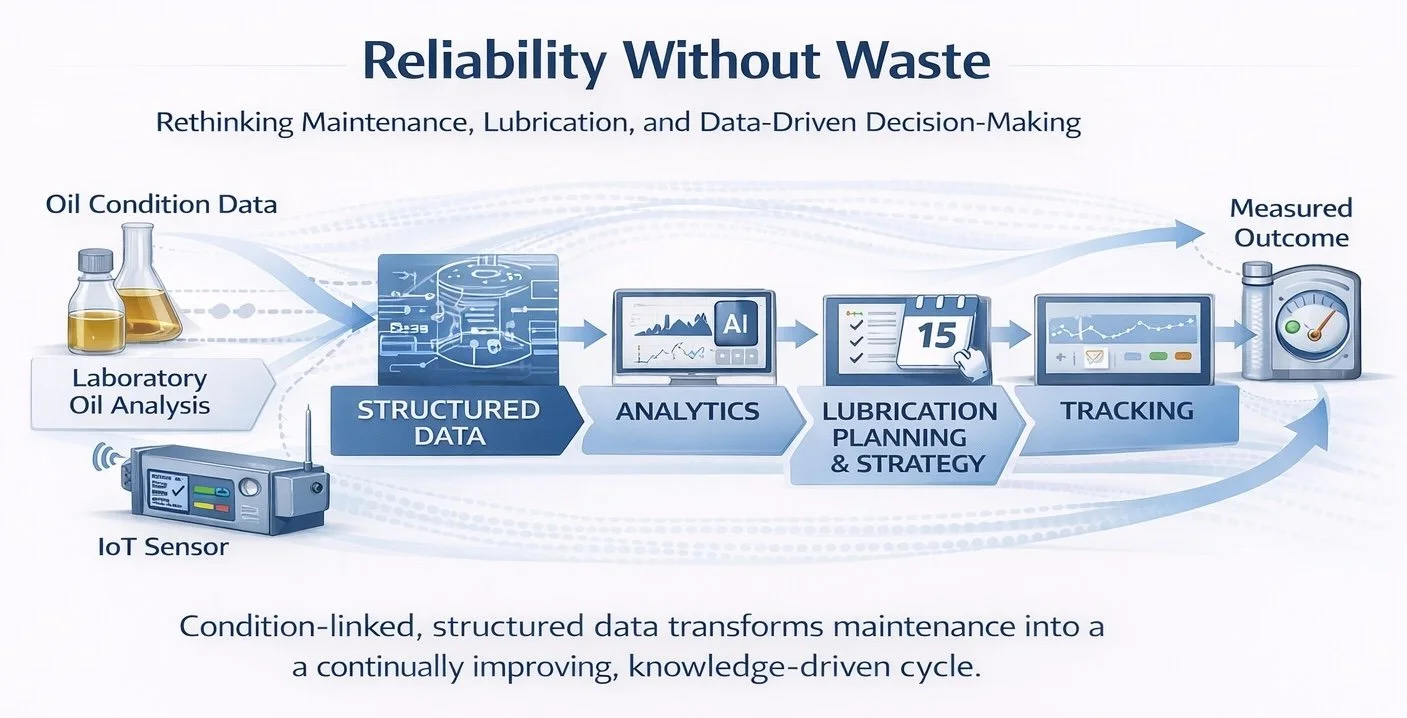
This three-part series explores how modern maintenance can move beyond interval-based thinking toward a structured, data-driven approach built around lubrication strategy and condition intelligence.
A central theme is oil condition monitoring — not because other monitoring methods are “wrong”, but because lubricant condition is both measurable and actionable, and it directly connects maintenance decisions to reliability outcomes and resource use. In practice, the strongest results come from combining oil condition data with other operational and condition signals (such as vibration, temperature, load, and process context) in the same analytical framework.
Across the next three articles, we will examine:
Part 1: From Scheduled Maintenance to Continuous Understanding
Why structured data management and consistent analytics are the foundation of modern reliability — and how condition monitoring (including oil condition) becomes more valuable when it is connected to asset context and history.
Part 2: Lubrication Strategy – Extending Oil Life Without Extending Risk
How real-time oil monitoring and laboratory diagnostics enable condition-based lubrication planning, safer oil life extension, and earlier detection of abnormal wear — while remaining grounded in evidence and outcomes.
Part 3: From Data Collection to Data Moat
Why unifying real-time and offline diagnostics (and other condition sources) creates long-term advantage, and how structured analytics and feedback loops turn maintenance into a learning system. We’ll also briefly clarify where different forms of AI help — and where structured data and engineering logic remain essential.
Throughout the series, one principle remains central:
When data is structured, comparable, and connected to outcomes, maintenance evolves from reactive action to informed strategy.
Reliability improves. Waste decreases. Emissions decline as interventions become better timed and more justified.
And knowledge compounds over time.
The objective of this series is to clarify a mindset:
Plan, track, and act based on structured condition data — and learn from every outcome.
Read all articles here:
Article 1: From Scheduled Maintenance to Continuous Understanding
Article 2: Lubrication Strategy: Extending Oil Life Without Extending Risk