
3-blog series - Part one
From Scheduled Maintenance to Continuous Understanding
By Eero Juustila, CTO
Industrial maintenance has traditionally been organized around time.
Oil is replaced after predefined operating hours. Components are inspected at scheduled intervals. Lubrication plans are standardized and repeated across similar assets. This approach was built for a world where internal machine condition could not be observed continuously, so maintenance decisions had to rely on experience, intervals, and safety margins.
Today, the limitation is no longer data availability. The limitation is how well we turn condition data into consistent decisions.
Oil condition monitoring provides a particularly practical foundation for continuous understanding because lubrication is directly involved in wear protection, contamination control, and heat transfer—and because oil carries measurable evidence of what is happening inside components. Oil condition does not change randomly; it shifts due to identifiable mechanisms such as contamination ingress, additive depletion, moisture accumulation, oxidation, and wear particle generation.
However, simply collecting oil data does not create reliability. The value comes from disciplined data management and analytics.
To support real decision-making, oil condition data must be managed as a structured dataset:
linked to the correct asset and component context
normalized across sources and measurement formats
trended over time with consistent interpretation logic
evaluated using deterministic analytics (rules, thresholds, trend rules) and—where appropriate—machine learning for pattern recognition
connected to actions taken and outcomes observed
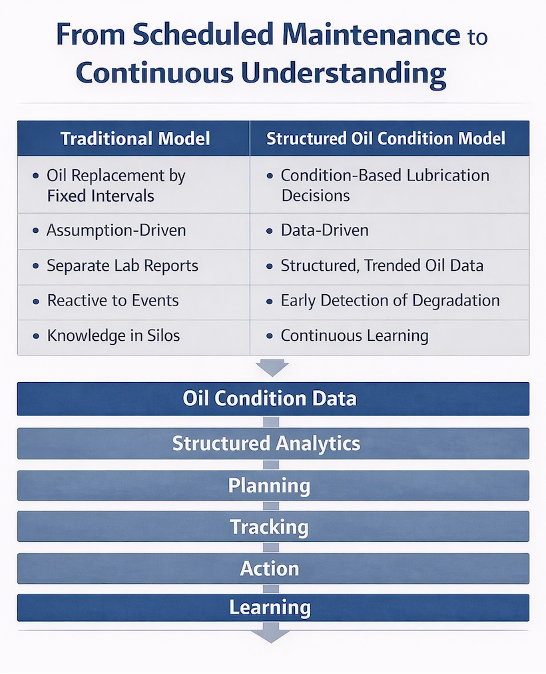
From calendar-based assumptions to data-driven, condition-based maintenance decisions.
This is the difference between “having lab reports” and running a condition-based lubrication and maintenance strategy.
Real-time oil sensors and laboratory analysis play complementary roles. Real-time sensors provide continuous visibility into selected condition indicators, enabling rapid detection of change and better tracking between sampling points. Laboratory diagnostics provide deeper evidence and broader characterization of lubricant and wear condition. The highest value is created when both are available and analyzed within the same system so that trends, context, and outcomes are preserved consistently.
When oil condition data is structured this way, the maintenance model changes. Instead of asking “Has enough time passed to do maintenance?”, the question becomes “What does the current condition trend indicate, and what action is justified for this specific asset?”
This shift reduces two persistent sources of waste and risk:
unnecessary interventions based on intervals rather than condition
delayed interventions because early signals were not trended, compared, or interpreted consistently
The reliability impact is straightforward: earlier identification of developing degradation mechanisms enables planned interventions instead of reactive breakdown response. The sustainability impact follows naturally: oil and components are replaced when condition requires it—not prematurely—reducing waste, logistics, and associated emissions.
The transition from scheduled maintenance to continuous understanding is not a matter of collecting more data. It is a matter of structuring oil condition data so it can drive planning, tracking, and action—and so that each decision becomes part of the system’s long-term learning.
The shift is not from maintenance to monitoring.
It is from assumption to structured data-driven planning.
In Part 2, we will focus on lubrication planning and how a data-driven lubrication strategy supports reliability and sustainability.