
Keep Every Fleet and Port Asset Running at Peak Performance

YOUR OPERATIONS, COVERED
Fluid Lifecycle Management Across Every Mode of Transport
From long-haul trucks and locomotives to container ships and port cranes, logistics assets depend on fluid integrity across engines, drivetrains, hydraulics and fuel systems. We cover them all.
LIFECYCLE MANAGEMENT
Most fluid problems in logistics don't happen overnight. They build up over thousands of operating hours — and become visible only after a breakdown on the road, at sea or in the terminal. Our lifecycle approach gives you visibility and control at every stage.
Full Fluid Lifecycle Management — From Commissioning to End-of-Life
Phase 1
Planning & simulation
Right fluid specifications from the start
Condition-based change intervals — not fixed schedules
Evaluate and compare lubrication strategies before committing
Phase 2
Operational control
All fluid data in one view — lab results and real-time sensors combined
Automated alerts and trend analysis across every asset and site
Data-driven actions: extended fluid life, less waste, fewer failures
Phase 3
End-of-life & reporting
Know exactly when a fluid needs to be changed
Reduce waste fluid volumes and disposal costs
Sustainability and compliance reporting — automated
✓ Reduce unplanned breakdowns and roadside failures
✓ Extend fluid and drivetrain service life
✓ Centralize fluid data across depots, routes and fleets
✓ Meet sustainability and emissions reporting requirements
MONITORING
Lab Analysis + Real-Time Monitoring — Complete Fluid Visibility
Two complementary monitoring methods, one integrated view. Whether you prefer periodic lab testing or continuous online monitoring — or both — we give you the data you need to act.
Lab analysis
Send fluid samples to our laboratory for comprehensive analysis. Every result comes with a Performance Statement: true condition, developing risks and clear action recommendations. Analysis contains e.g.:
Chemical condition — oxidation, viscosity, additive health, TAN/TBN
Cleanliness — particle count, sizes, ISO cleanliness codes and microscopic assessment
Contamination & wear — water content, wear metals and component-specific indicators (ICP)
Coolant condition — pH, glycol concentration, reserve alkalinity, inhibitor levels, ATP
Fuel quality — water, microbial contamination, oxidation stability, density and viscosity

Real-time monitoring
Continuous fluid condition data from IIoT sensors, flowing securely to Fluid Eye® via edge connectivity. AI-powered analytics detect trends and anomalies — automated alerts and clear guidance, 24/7.
Four monitoring packages, used individually or combined:
Oil Quality Trend — oil quality index and temperature
Cleanliness Monitoring — particle counts, sizes, ISO codes and humidity
Chemical Analysis — water, oxidation, antioxidant depletion, TAN/TBN and viscosity
Coolant & fuel monitoring — conductivity, pH, temperature and tank levels
Expandable with custom parameters and CMMS integration.
OPTIMIZATION
Fluid Optimization — Better Performance, Longer Life, Less Waste
Monitoring tells you what's happening. Optimization is what you do about it. We offer a full range of interventions to restore fluid quality, protect equipment, and reduce total fluid costs.
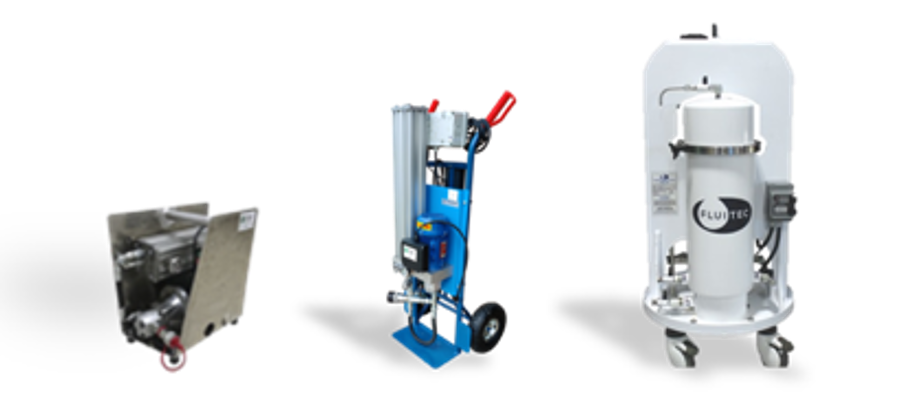
Impurity removal & filtration
Remove water, particles and other contaminants before they cause damage — designed for demanding transport conditions, high-duty cycles and critical uptime requirements.
Includes: Offline filtration units, water removal, particle filtration, fuel polishing systems.
Additives & fluid conditioning
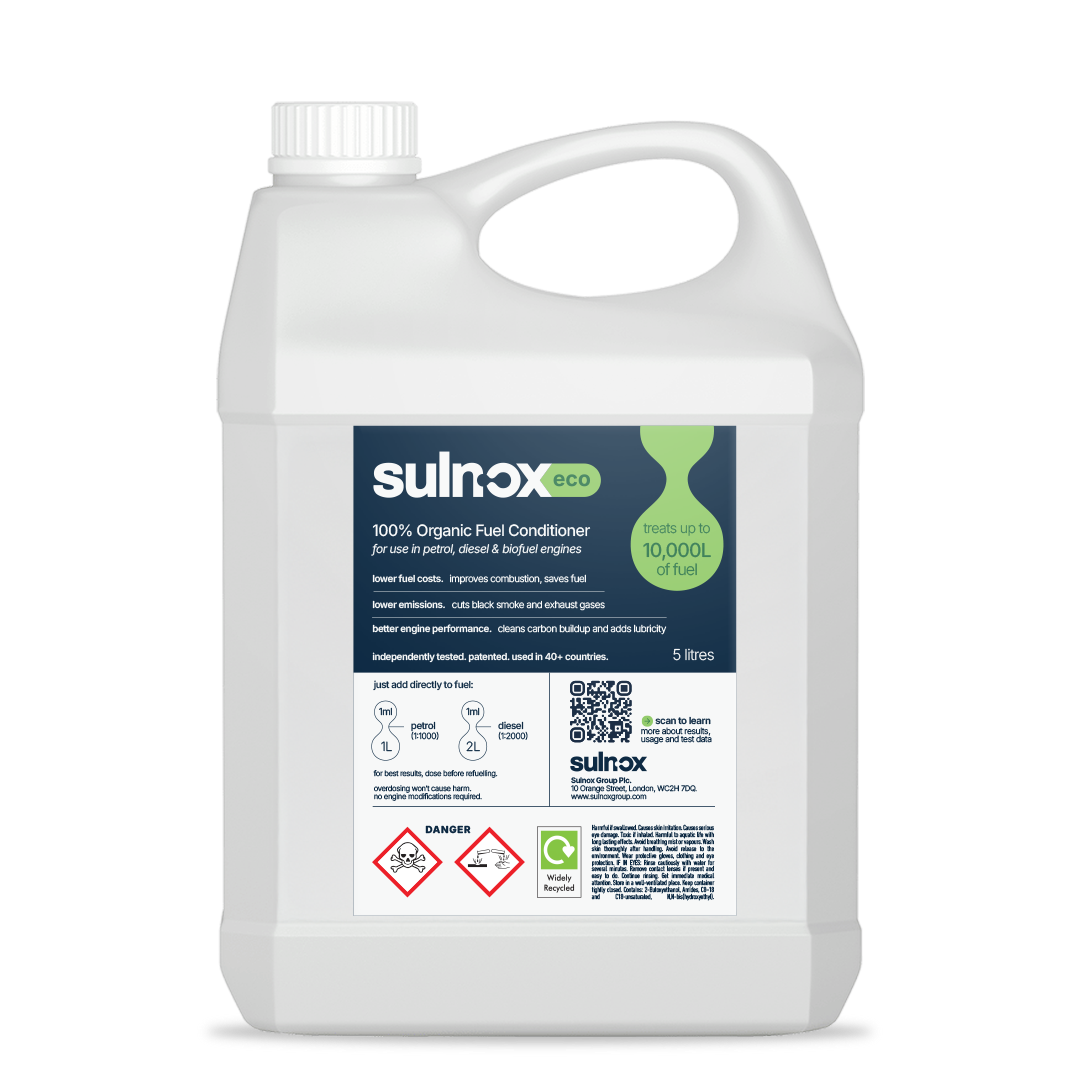
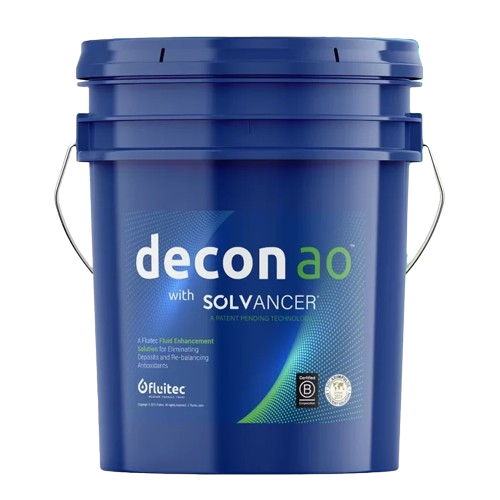
Restore depleted additive packages and extend fluid service life without full oil changes. Reduce waste and procurement costs while maintaining full protection.
Includes: Antioxidant top-ups, inhibitor treatments, fuel conditioner and customized additive programs.
Projects & expert advice
Not every fluid challenge fits a standard solution. Our engineers work directly with your teams to solve complex fluid problems, optimize change intervals and build fluid management programs.
Includes: On-site assessments, fluid management audits, change interval optimization, training and support.
✓ Extend oil drain intervals by x2-5 with condition-based maintenance
✓ Reduce waste fluid volumes and disposal costs
✓ Reduce fuel system failures and filter clogging
✓ Lower total cost of ownership across your entire fleet
DATA MANAGEMENT
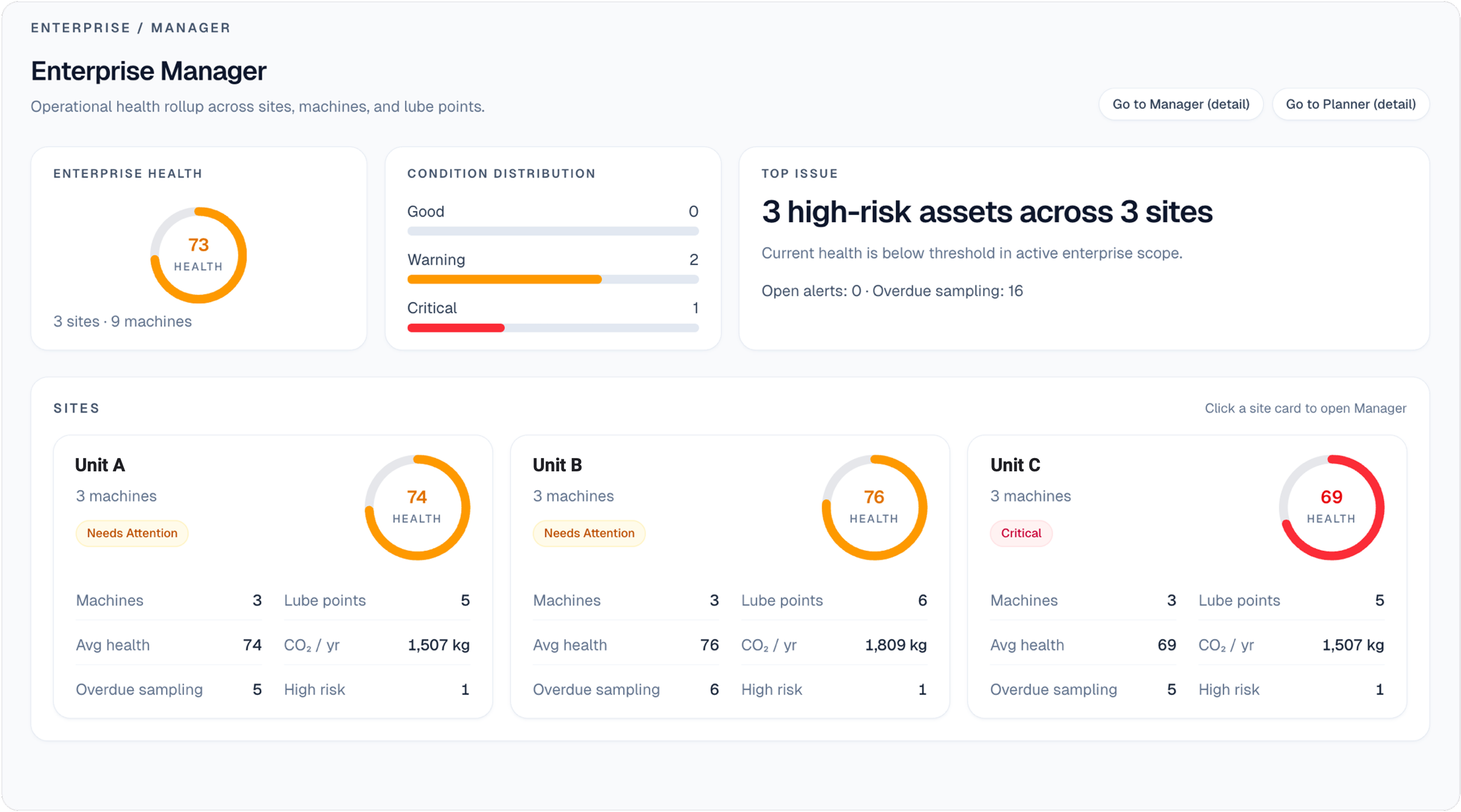
Fluid Eye® – All Your Fleet Fluid Data in One Place
Managing fluid data across hundreds of vehicles, multiple depots and mixed asset types is a massive operational challenge. Fluid Eye brings it all together — lab results, sensor data, maintenance history, alerts and reports — in one centralized platform.
One view, every asset — from a single vehicle to enterprise-level multi-depot fleet
Integrated data sources — lab results and real-time sensor data in the same dashboard
Smart alerts — automatic notifications when action is needed, across any asset
Fleet health scores — every asset scored and ranked, making large fleets comparable and manageable
Benchmarking — compare performance across depots, operators, vehicle types and industry peers
Reporting & compliance — maintenance reports, sustainability data and audit trails with one click
No spreadsheets. No scattered reports. Just clear, actionable fluid intelligence.

"Oil condition management is a reliable way to ensure stable and uninterrupted operations."
Markus Lehti, Maintenance Engineer, Keravan Lämpövoima
CUSTOMER SUCCESS
Real outcomes from logistics operators who have made fluid lifecycle management a core part of their fleet reliability and sustainability strategy.
Results from Logistics Operations
Road Transport
Heavy trucks and buses operate under demanding duty cycles — long distances, varying loads and extreme temperature ranges. Engine oil, transmission fluid and coolant must perform reliably across every route and season. Condition-based management reduces roadside failures and keeps fleets moving.
Key equipment: Diesel and gas trucks, heavy buses, semi-trailers, auxiliary equipment
What we monitor: Engine oil condition, viscosity, wear metals, additive depletion, coolant condition, fuel quality, transmission oil condition
What we optimize: Condition-based oil drain intervals, coolant management, fuel quality programs, additive top-ups
Common failure modes we prevent:
Engine failure from degraded or contaminated oil
Transmission damage from overheated or depleted fluid
Coolant system corrosion from inhibitor depletion

Rail Transport
Locomotives and rail infrastructure operate on tight schedules with high asset utilization. Diesel-electric locomotives carry multiple fluid systems simultaneously — traction motors, diesel engines, hydraulic systems and cooling circuits — each requiring consistent monitoring to maintain reliability.
Key equipment: Diesel and electric locomotives, railcars, track maintenance equipment, auxiliary rail vehicles
What we monitor: Engine oil condition, wear metals, viscosity, hydraulic oil cleanliness, coolant condition, fuel quality
What we optimize: Condition-based maintenance programs, oil drain interval extension, contamination control, coolant management
Common failure modes we prevent:
Traction motor and engine damage from oil degradation
Hydraulic system failure from particle contamination
Unexpected service interruptions from undetected fluid deterioration
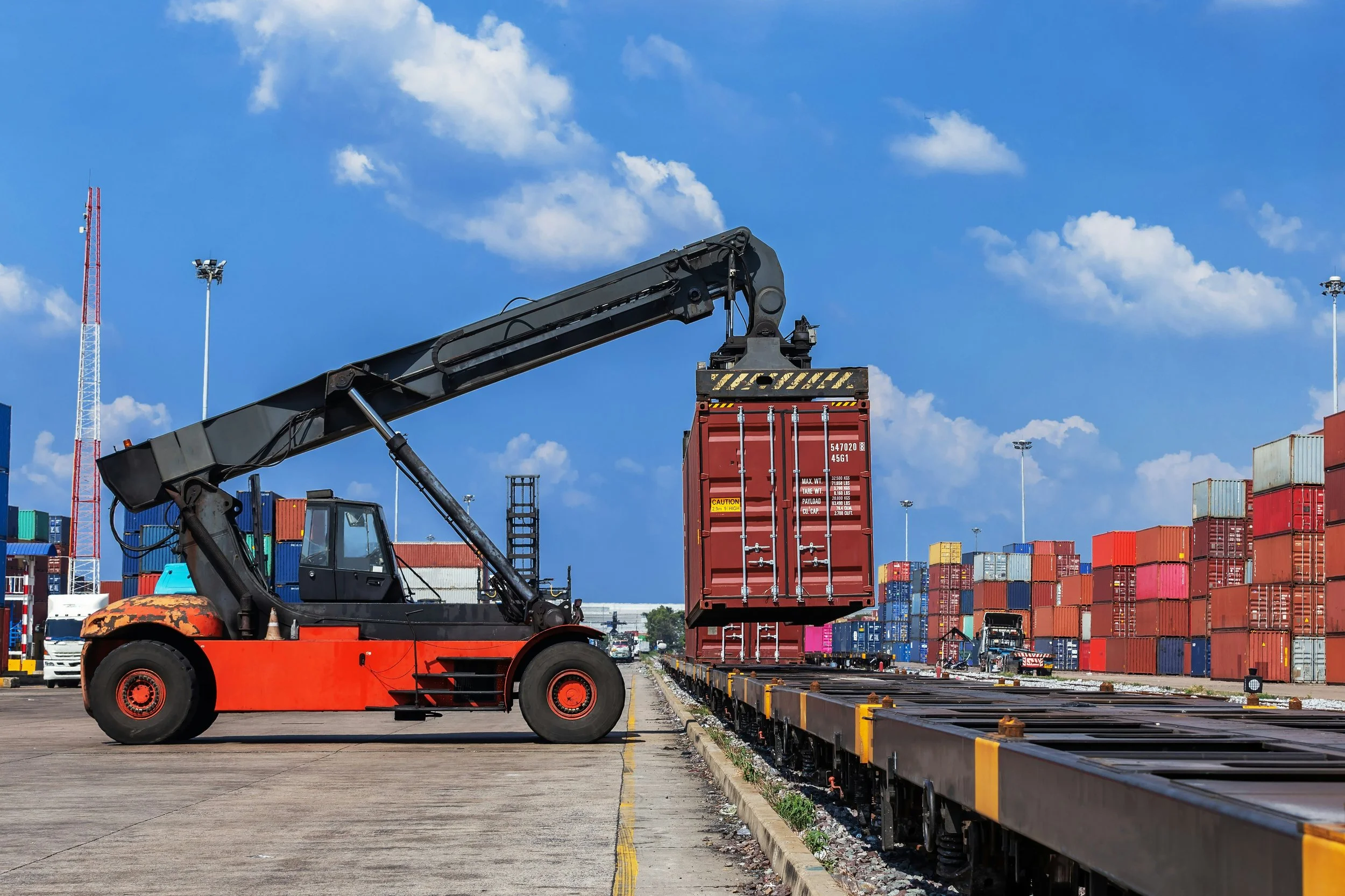
Maritime
Marine engines and auxiliary systems operate in harsh saltwater environments under continuous load. Engine oil, hydraulic fluid and fuel quality are critical to vessel reliability and regulatory compliance. Fuel management is particularly important — poor fuel quality is a leading cause of marine engine failures.
Key equipment: Main propulsion engines, auxiliary engines, hydraulic systems, stern tubes, fuel systems
What we monitor: Engine oil condition, wear metals, viscosity, TBN depletion, hydraulic oil cleanliness, fuel quality (water, microbial, stability)
What we optimize: Condition-based oil management, fuel polishing and treatment, hydraulic system filtration, coolant management
Common failure modes we prevent:
Main engine failure from fuel contamination or oil degradation
Hydraulic system failure from water and particle ingress
Injector damage from poor fuel quality
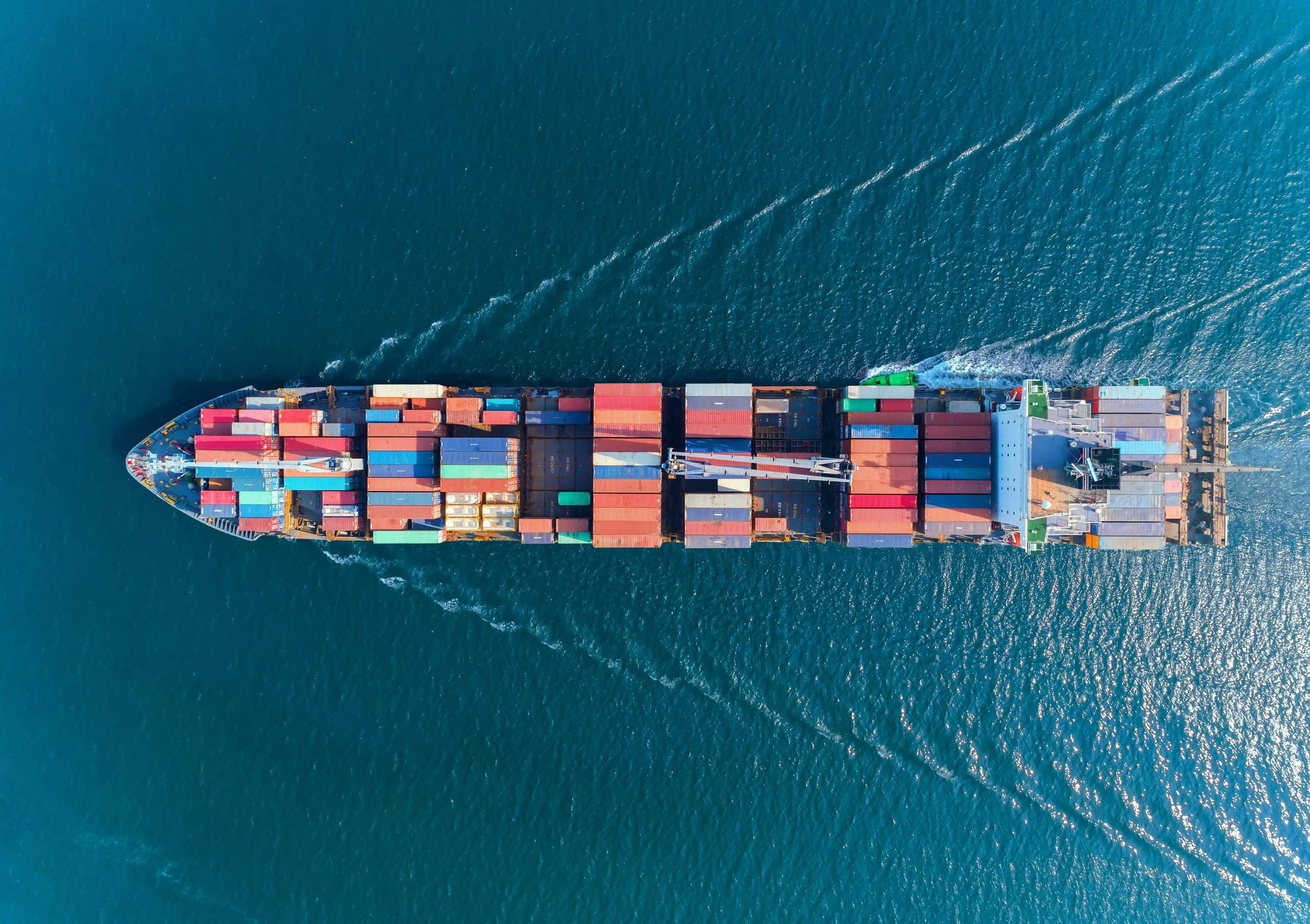
Ports & Terminals
Port equipment operates around the clock in demanding conditions — heavy loads, dusty environments and exposure to saltwater accelerate fluid degradation. Cranes, reach stackers and terminal tractors are critical assets where unplanned failures directly impact cargo throughput.
Key equipment: Ship-to-shore cranes, RTG and RMG cranes, reach stackers, terminal tractors, forklifts, yard equipment
What we monitor: Hydraulic oil cleanliness and condition, gear oil condition, wire rope lubrication, engine oil condition, contamination and particle count
What we optimize: Filtration and cleanliness control, condition-based oil management, contamination removal, drain interval optimization
Common failure modes we prevent:
Crane hydraulic failure from particle contamination
Gearbox and drivetrain damage from degraded lubricant
Equipment downtime from undetected fluid deterioration
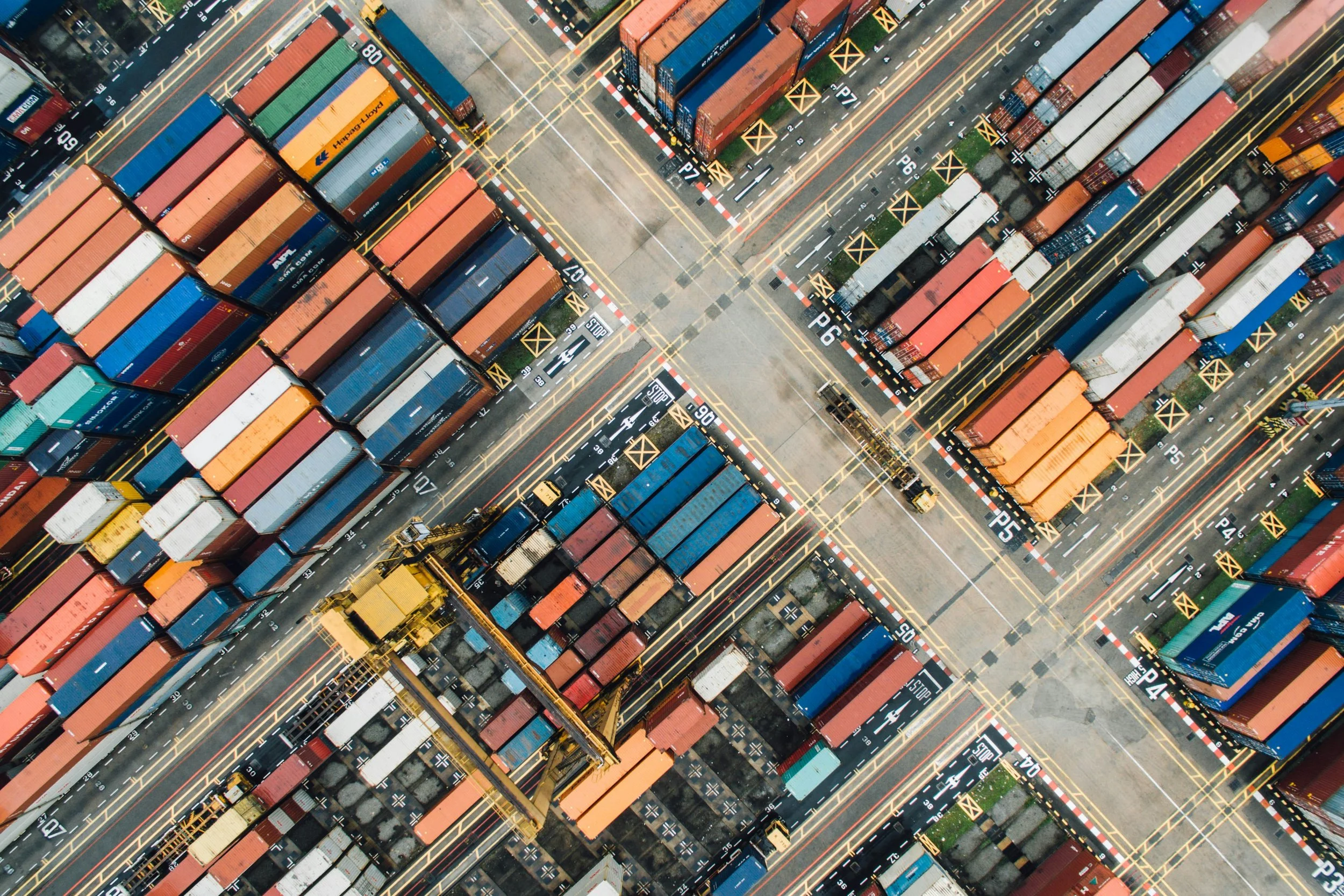
Fleet Management
Large logistics operators manage hundreds or thousands of assets across multiple depots, routes and countries. Individual oil samples and manual records don't scale. Fluid Eye® gives fleet managers and maintenance directors a centralized view of every asset's fluid condition — starting from lab analysis alone, without requiring real-time sensors on every vehicle.
Every sample result is scored and normalized into a fleet health score — making assets across different vehicle types, depots and operators directly comparable. Spot the worst performers, track improvement over time, and benchmark your fleet against industry peers.
What we monitor: Oil condition trends across entire fleets, alert thresholds per asset type, fluid change compliance, depot-level performance comparison
What we optimize: Fleet-wide drain interval programs, condition-based maintenance scheduling, fluid standardization across mixed fleets
Common failure modes we prevent:
Premature engine failures from undetected oil degradation across large fleets
Inconsistent maintenance standards across depots and operators
Unnecessary oil changes driven by schedule rather than actual condition

Fuel Management
Fuel is one of the largest cost items in any logistics operation — and one of the most overlooked from a quality perspective. Diesel, HVO and LNG stored in depot tanks degrades over time, and poor fuel quality causes filter clogging, injector damage and engine failures across entire fleets simultaneously.
What we monitor: Water content, microbial contamination (ATP), particle count, oxidation stability, density and viscosity, tank levels
What we optimize: Tank circulation and polishing systems, biocide treatment, fuel conditioner programs, storage management
Common failure modes we prevent:
Fleet-wide filter clogging from microbial growth in depot tanks
Injector and pump damage from water and particle contamination
Engine performance degradation from oxidized or off-spec fuel
EXPLORE FURTHER
Resources for Logistics Professionals
Ready to take control of your fleet fluid management?
Every logistics operation is different — fleet size, asset mix, depot structure and monitoring maturity all vary. Talk to one of our specialists and we'll map out the right approach for your operation.