
Engines, hydraulics, gearboxes and fuel, on land and at sea
Oil in heavy equipment should be changed when its measured condition says it is time, not when a calendar or an hour meter does. A fixed interval is an estimate made for typical operating conditions. Real duty cycles, dust, load, idling and fuel quality differ from machine to machine, so a fixed interval changes some oil too early and some too late.
Condition-based oil change replaces the estimate with data. The oil is sampled or monitored, trended against a baseline, and then kept in service, cleaned, topped up or changed depending on what the data shows. The principle is the same for every fluid in a machine, but each system ages in its own way.
This guide covers:
Why fixed intervals fall short
Engine oil, hydraulic oil, gear oil and fuel in the same machine
How the approach plays out in mining, ports, shipping and road fleets
How to run it in practice
From single machines to fleet-level management
Fuel and tank levels as part of the same plan
Why Fixed Intervals Fall Short
Drain intervals from the original equipment manufacturer (OEM) are a sound starting point. They are written to protect the machine across a wide range of conditions, so they are generous for gentle duty and can be too long for severe duty. The calendar cannot tell the difference. Two errors follow:
Changing too early. Serviceable oil is drained and disposed of. The cost is not only the oil: it includes labor, machine downtime, waste oil handling and the CO₂ from producing and transporting new oil. Every change also opens the system to contamination, so fresh oil is not automatically cleaner than the oil it replaces.
Changing too late. Water, particles, oxidation and additive depletion build up without any visible sign. By the time noise, heat or a warning light appears, wear metals have usually been rising for a long time.
Neither error can be seen without measurement. Oil condition monitoring and laboratory analysis show which machines can safely run longer and which need attention sooner, and that is the whole case for condition-based change.
Four Fluids in One Machine, Four Different Answers
A heavy machine rarely runs on one fluid. A single excavator, crusher, truck or vessel typically has an engine, hydraulics, one or more gear drives and a fuel system, and each fluid degrades for different reasons. A single interval for the whole machine hides that.
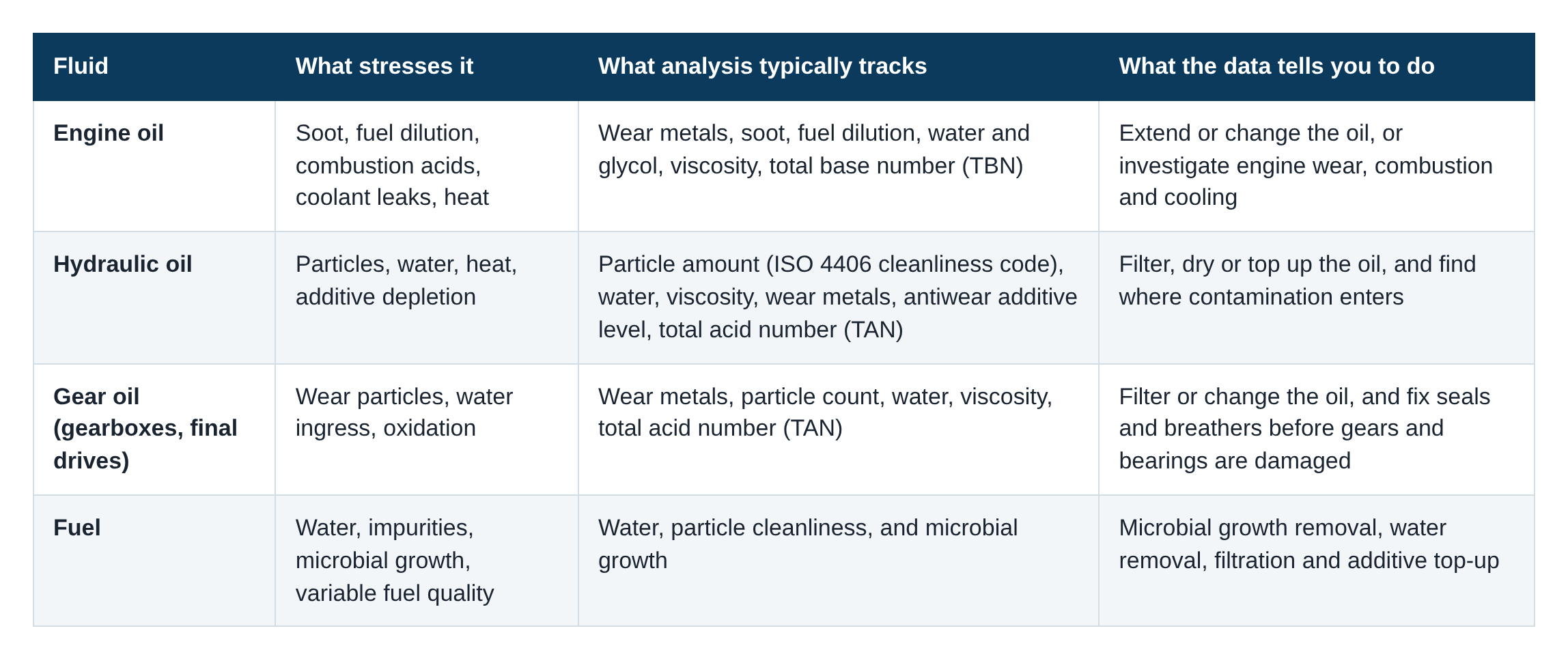
Four fluids in one machine, four different answers
Engines. Soot and fuel dilution say as much about combustion health as about the oil. TBN shows how much alkaline reserve is left to neutralize combustion acids. Rising wear metals in otherwise healthy oil point to a component problem, not an oil problem.
Hydraulics. Cleanliness drives component life. The ISO 4406 code (from the International Organization for Standardization) expresses particle counts by size, and pumps and proportional valves are sensitive to it. Often the right action is filtration, not a change.
Gearboxes and final drives. Water and wear particles are the main threats, and wear metals often show developing damage well before noise or heat does. TAN rises as the oil oxidizes or picks up acidic contamination, so it is read as a change from the fresh-oil baseline, not as an absolute value.
Fuel. Water and sediment collect in tanks, and fuel quality varies by supplier and batch. Problems tend to show up twice: in injectors and filters, and in the engine oil as soot or fuel dilution.
The Decision Loop at a Glance
Every reading ends in one of three outcomes, and the next reading confirms whether the action worked. That feedback is what separates condition-based change from guessing at a longer interval.
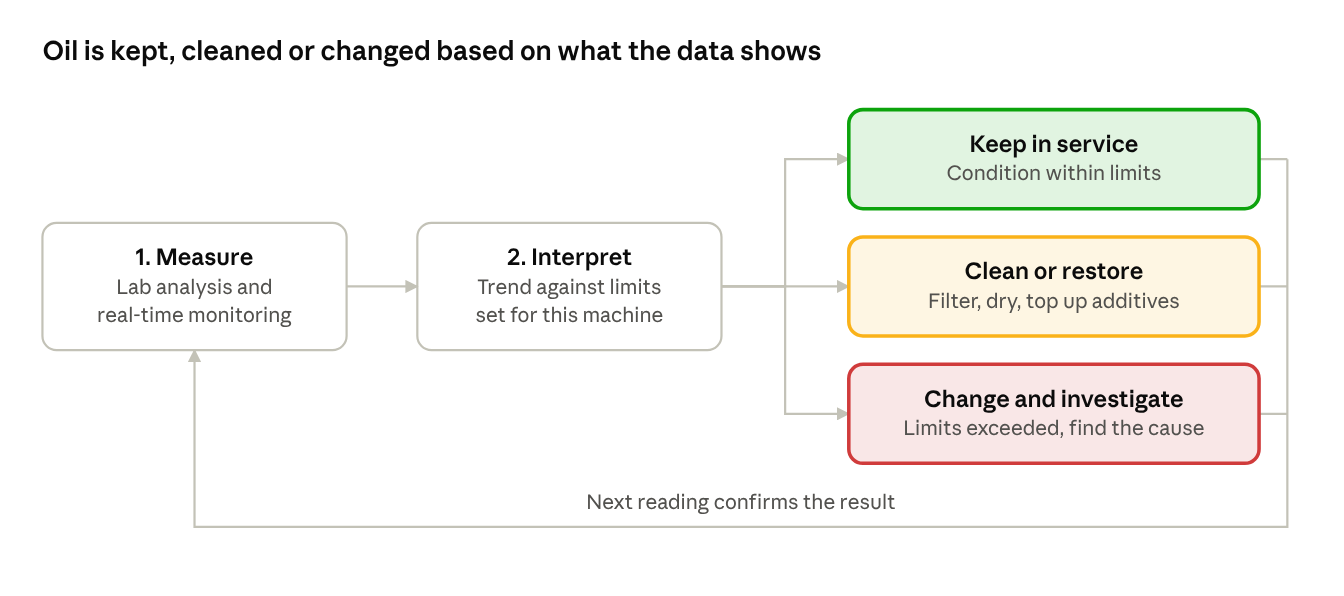
Every reading ends in one of three outcomes
Mining, Ports, Shipping and Road Fleets: Same Principle, Different Duty
The method does not change between sectors, but the stresses do. That shifts which parameter matters most and how costly a missed warning is.
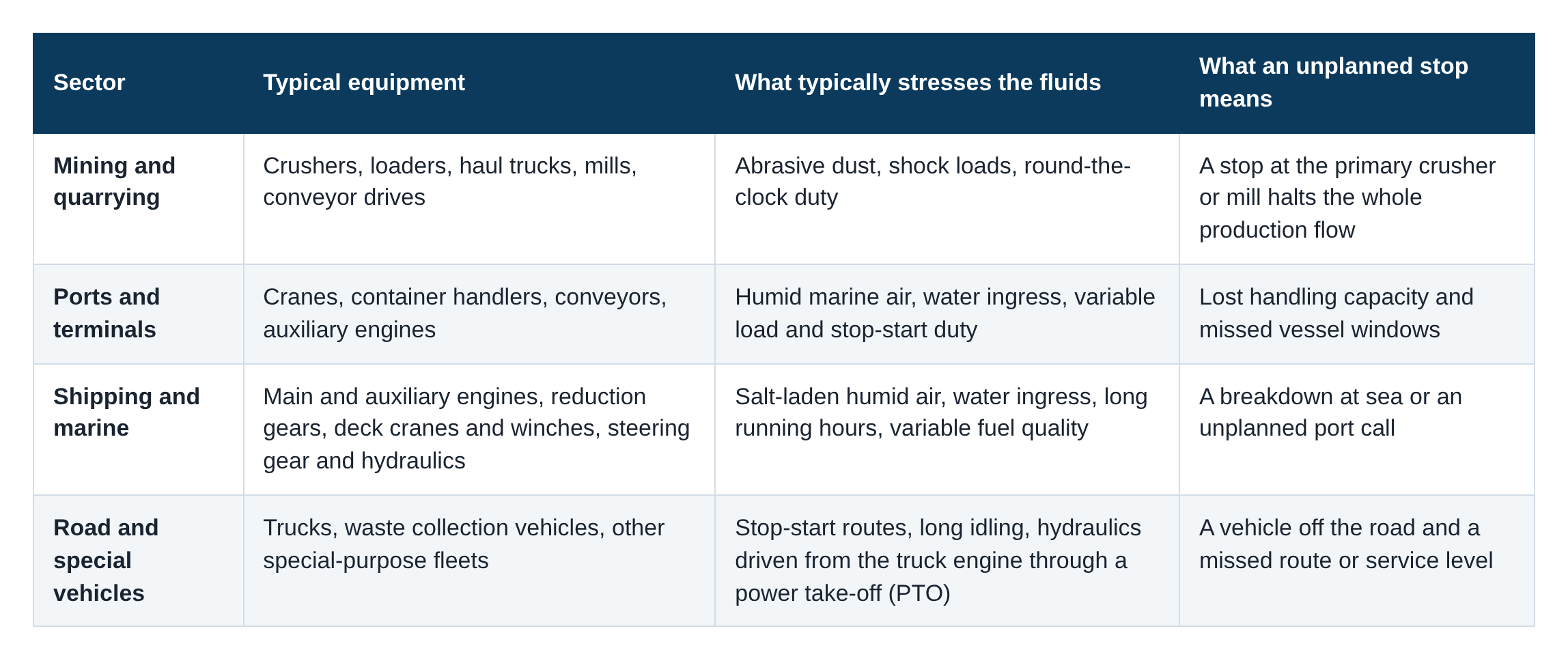
Same principle, different duty: what stresses the fluids in each sector
A PTO is a drive that lets the truck engine power a separate hydraulic pump. Waste compactors, lifts and loader cranes work this way, so the engine oil and the hydraulic oil age under the same duty cycle but in different ways.
A vessel is effectively a fleet in one hull: engines, gears, hydraulics, cranes, winches and several fuel tanks, all running for long periods far from a workshop. Sampling is planned around port calls, and remote monitoring data fills the gaps between them. Fuel quality is a larger variable at sea than on land, which is covered in Maritime Fuel Optimization.
Field result: Sibelco Nordic (ball mill gearbox). The Kemiönsaari plant grinds rock around the clock, so dust is constant. Since Fluid Eye® Trend monitoring was installed in 2019, oil life has tripled and a bearing failure estimated at over €50,000 has been avoided. The case also shows why data beats routine: an oil change made strictly by the maintenance program left the mill with lower-quality oil than before, most likely because rock dust entered through the pumping equipment. Read the full case →
Field result: Suomen KiviSora Oy (mobile crushers). Oil analysis, real-time monitoring and a mobile oil maintenance unit showed that hydraulic oil performance stayed good, which put the need for a semi-annual oil change in question. An alert also helped prevent a heat-related failure, with substantial savings from the avoided failure. Read the full case →
More examples from mining, recycling, energy and logistics are collected on the customer cases page.
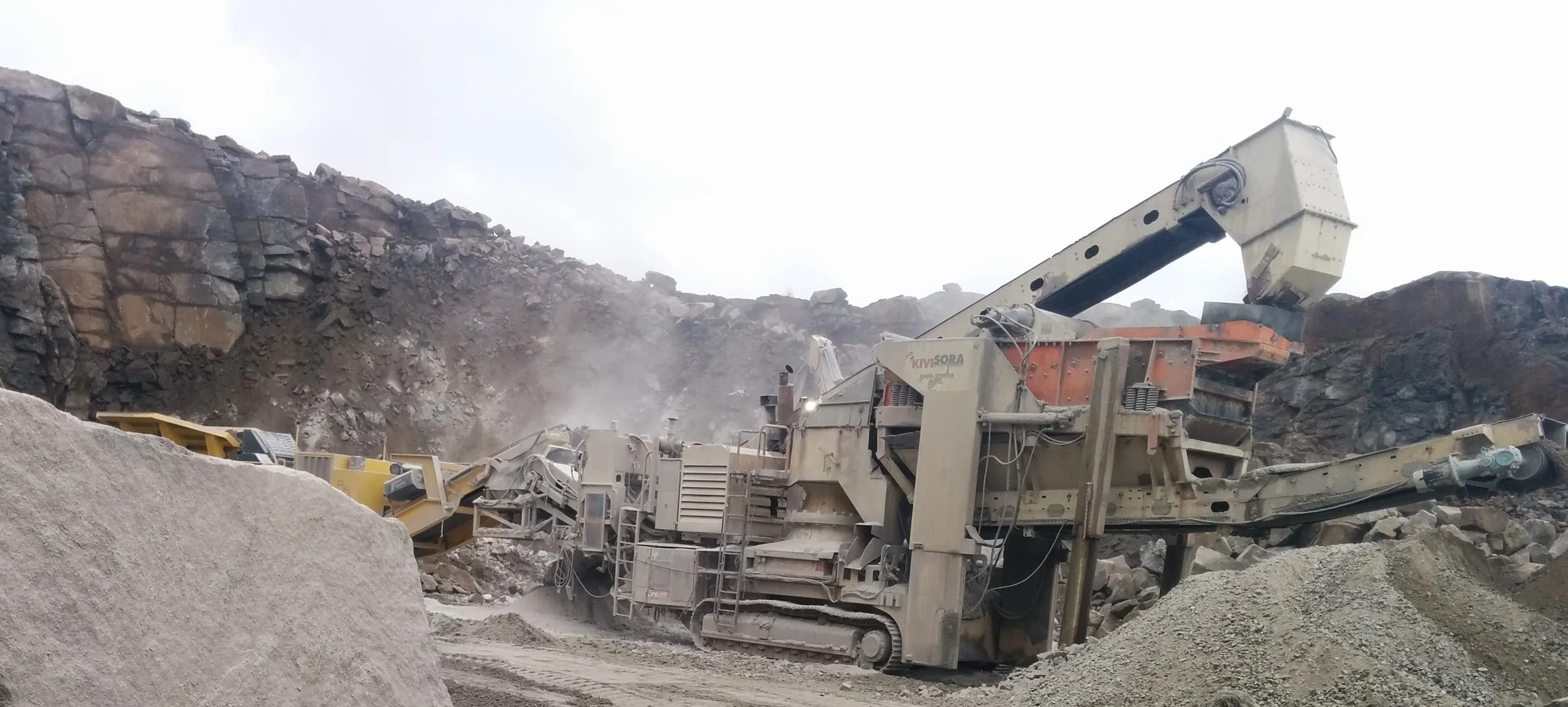
Mobile crusher
How to Run It in Practice
Condition-based change works when four things are connected. Each step builds on the one before it.
Set the baseline. Start with a lubrication plan built on a current state assessment: which fluids each machine uses, where samples can be taken, what the OEM limits are and which assets cost the most when they stop. Begin with those assets.
Combine laboratory analysis with real-time monitoring. Laboratory oil analysis gives the deep diagnostic picture at each sampling point. Real-time monitoring adds continuous visibility between samples, with alarms for the assets where a surprise is expensive. Field conditions such as dust, vibration and weather mean the hardware must be as durable as the machine. For the trade-offs, see Oil Analysis vs Real-Time Oil Condition Monitoring.
Manage the data across the fleet. Results from lab samples, sensors and service actions need to sit in one structure, so that a single reading can be compared with its own history and with similar machines. The next section covers why this step carries the most value.
Act on the data. The reading leads to an action: keep the oil in service, filter or dry it, restore additives, or change it. On-site oil maintenance units bring these actions to the machine instead of the machine to the workshop. See lubrication optimization.
From Single Machines to Fleet-Level Management
A single oil report answers one question about one machine. The larger value appears when hundreds of results are held in one place and can be compared. Laboratory analysis is the backbone of this: samples are usually taken from every machine, so a whole fleet can be managed with lab data, and it becomes more useful as volume grows, because every new sample sharpens the baseline for the next one. Real-time monitoring is then added alongside it on the more critical and larger machines, where continuous visibility between samples is worth the investment.
Comparability. Machines of the same class, doing similar work, should age similarly. When one does not, it stands out: a gearbox running hotter than its peers, a hydraulic system that needs filtration twice as often, an engine with fuel dilution that its sister units do not have.
Benchmarking. The same view works across sites, vessels, contractors and oil brands. It shows which sites keep fluids clean, which suppliers perform and where practice differs for no good reason. Health scores make machines and fluids comparable across machine and fluid categories, so an engine, a gearbox and a hydraulic system can be ranked on the same scale.
Fleet-level optimization. Drain intervals, filtration schedules and sampling frequency can be set per machine class and duty cycle instead of per machine, and then adjusted as evidence builds. Patterns also point to root causes. In an analysis of a large mining fleet, over 65% of oil changes were contamination-driven, which points to contamination control, not the calendar, as the lever.
Reporting. The same data supports three management views at once, as the table shows.
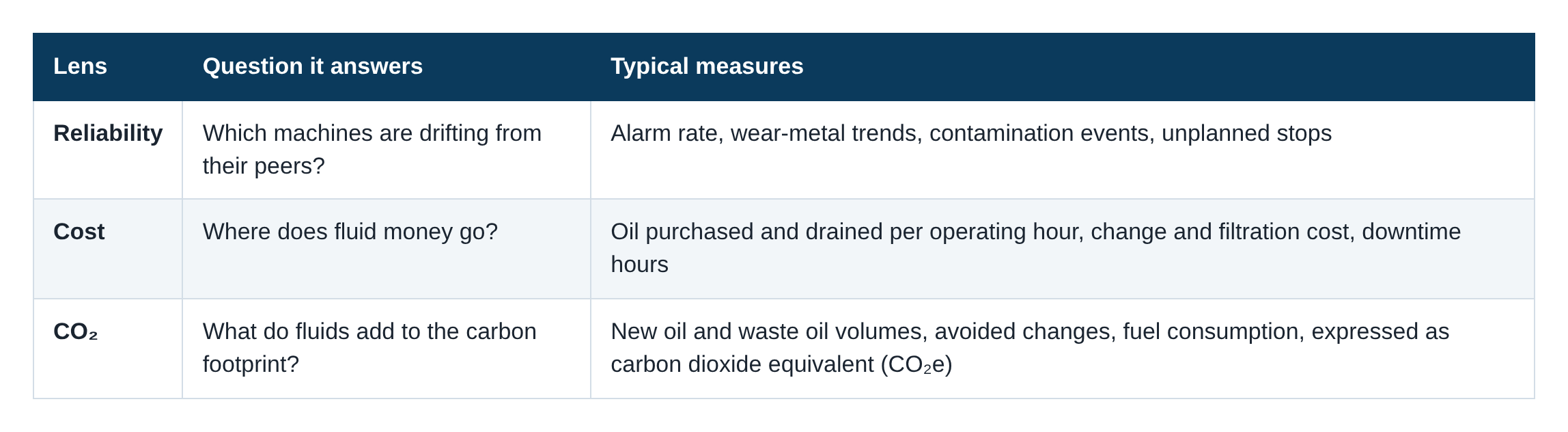
Fleet-level reporting: reliability, costs and CO2
This only works if the data model is shared: lab results, online sensor readings, service actions, fuel use, tank levels and maintenance records tied to the same asset. Without it, each report is a separate project. Platforms such as Fluid Eye® are built around this idea.
Fuel Quality and Efficiency in the Same Plan
Engine oil and fuel share one engine and affect each other. Soot and fuel dilution, two of the main stressors of engine oil, start in combustion. Fuel is also one of the largest and least controllable cost lines in heavy operations, as covered in Why Industrial Lubricant and Fuel Costs Keep Rising.
Two levers apply, in the same way condition data extends oil life:
Fuel quality and cleanliness. Tanks collect water through condensation, and sediment from storage and handling. Water supports microbial growth in diesel, and particles clog filters and wear injectors. Fuel filtration and regular cleanliness checks follow the same logic as hydraulic oil: measure, trend and act.
Combustion efficiency. Better atomization and more complete combustion reduce deposits and fuel consumption, and lower soot loading in the oil. Combustion conditioners are one route, and fuel optimization covers the options for land and marine engines.
As with oil, the effect should be verified, not assumed. Oil analysis shows whether soot and fuel dilution fall, and consumption data shows whether the engine uses less fuel for the same work.
Keeping Operations Running: Tank Level Monitoring
Oil and fuel in good condition still have to be in the right place at the right time. A machine that runs out of oil or fuel stops just as surely as one with a failed bearing, and manual tank checks across a spread-out site or fleet are easy to miss.
Measuring tank levels for lubricants and fuel, and connecting them to purchasing, lets deliveries be triggered by actual stock instead of a reminder or a quick look at the tank. Consumption calculated from tank levels, and any reduction in it, can be brought into fleet management through the same data management and become part of the reporting on reliability, costs and CO₂. It is also a useful early signal of leaks and abnormal operation.
Frequently Asked Questions
How often should oil be changed in heavy equipment? There is no single answer. OEM intervals are the starting point, and condition data shows whether the oil in your machine, under your duty cycle, needs changing earlier or can safely run longer.
What is a condition-based oil change? It means changing, cleaning or topping up oil based on measured condition, such as wear metals, contamination, viscosity and additive level, instead of a fixed time or operating hours.
Can hydraulic oil life be extended without changing the oil? Often, yes. When the oil is degraded mainly by particles or water, filtration and drying can restore it, and additive top-ups restore depleted additives. Analysis shows which of these applies.
Where should a fleet or site start? With the machines where an unplanned stop costs the most, and where oil volumes and change costs are highest.
Does condition-based oil change work on ships? Yes. Vessels run long hours with engines, gears, hydraulics and cranes, and often far from a workshop. Samples are taken at planned port calls, and remote monitoring covers the periods between them. Fuel quality matters more at sea, so fuel cleanliness is followed alongside the oil.
Why compare machines across a fleet? One result tells how a machine is doing. A comparison tells whether that is normal for its class, which makes outliers, contamination sources and unnecessary changes visible, and gives reliability, cost and CO₂ reporting a common data basis.

Fluid Intelligence: One Fluid Lifecycle for Lubricants, Fuel and Availability
Fluid Intelligence manages the full lifecycle of industrial fluids on the Fluid Eye® platform. For lubricants that means planning, laboratory analysis, real-time monitoring and optimization. For fuel it means combustion improvement and cleanliness control. For availability it means tank level monitoring of lubricant and fuel tanks. All of it feeds one data model, so every fluid a machine depends on can be compared and reported at fleet level.
Related Solutions from Fluid Intelligence
Oil Analysis: laboratory diagnostics for engines, hydraulics and gearboxes.
Connected Oil® Monitoring: real-time oil condition monitoring between samples, with alarms and condition reports. Tank level can be added as a parameter.
Lubrication Optimization: filtration, additive top-ups, on-site oil maintenance and condition-based change decisions.
Fuel Optimization: Sulnox combustion conditioner, fuel filtration and fuel cleanliness.
Lab & Oil Data Manager: fleet-level trends, health scores, benchmarking and reliability, cost and CO₂ reporting.
Tank level monitoring: lubricant and fuel tank levels, with automated re-orders triggered by actual stock.
Next Steps
Explore Connected Oil® real-time oil condition monitoring →
Oil analysis vs real-time monitoring: key differences →
How oil analysis improves equipment reliability →
Why industrial lubricant and fuel costs keep rising →
Want to see where your fluids can work harder?
Fluid Intelligence helps industrial teams connect oil analysis, real-time monitoring, fuel optimization and tank level monitoring into one fluid lifecycle approach.