
Why are the world’s largest technology companies building AI data centers in Finland, and what will decide which projects succeed?
Finland is now one of the most closely watched locations for AI infrastructure in Europe. Google has announced at least €13 billion for Finnish digital infrastructure over the next two years, and the French AI company Sesterce has proposed a campus in Jämsä worth more than €10 billion. Microsoft, atNorth and Verne are building or preparing sites of their own. Grid operator Fingrid counts nearly 5 gigawatts (GW) of planned data center capacity under signed connection agreements. Together with other consumption projects such as electric boilers, signed agreements would raise national electricity consumption by almost 40 percent from the 2025 level if all were fully implemented.
The reasons go beyond a cold climate. Finland offers low-carbon electricity, an industrial base, stable institutions and district heating networks that can turn waste heat into a product. Rapid growth does not come without growing pains, and grid capacity, permitting and policy are where the most development work remains. This article gives an overview of what is happening, why operators keep coming, and what will shape how much gets built. More articles on the topic will follow.
THE AI DATA CENTER FLUID IMPERATIVEThis article follows our earlier piece, Fluid Lifecycle Management for AI Data Centers, and the white paper behind it. That article sets out the nine mission-critical fluid systems behind any AI data center. This one looks at why so many of them are being planned in Finland right now.
A global buildout reaches the Nordics
AI is changing what data centers need. Training and running large models concentrates computing in dense facilities that draw large, steady power and increasingly rely on liquid cooling. JLL expects global operational capacity to roughly double from about 100 GW to about 200 GW by 2030, with spending approaching $3 trillion including real estate and IT equipment. Grid connections, transformers and specialist engineers have become the scarce inputs, and waits of more than four years for a connection are now typical in primary markets.
For developers, finding a site is therefore less a property deal than a search for deliverable power, connectivity and certainty over decades of operation. In Finland that search covers new campuses and also former industrial sites, which may already have grid connections, water and land. Google's Hamina data center, converted from a paper mill about 15 years ago, is the early example, and Sesterce's Jämsä proposal applies the same logic to another former paper mill, at Kaipola.
What is happening in Finland
The pipeline now spans hyperscale cloud, AI-focused campuses, colocation and high-performance computing, spread from the Helsinki region to Northern Finland.
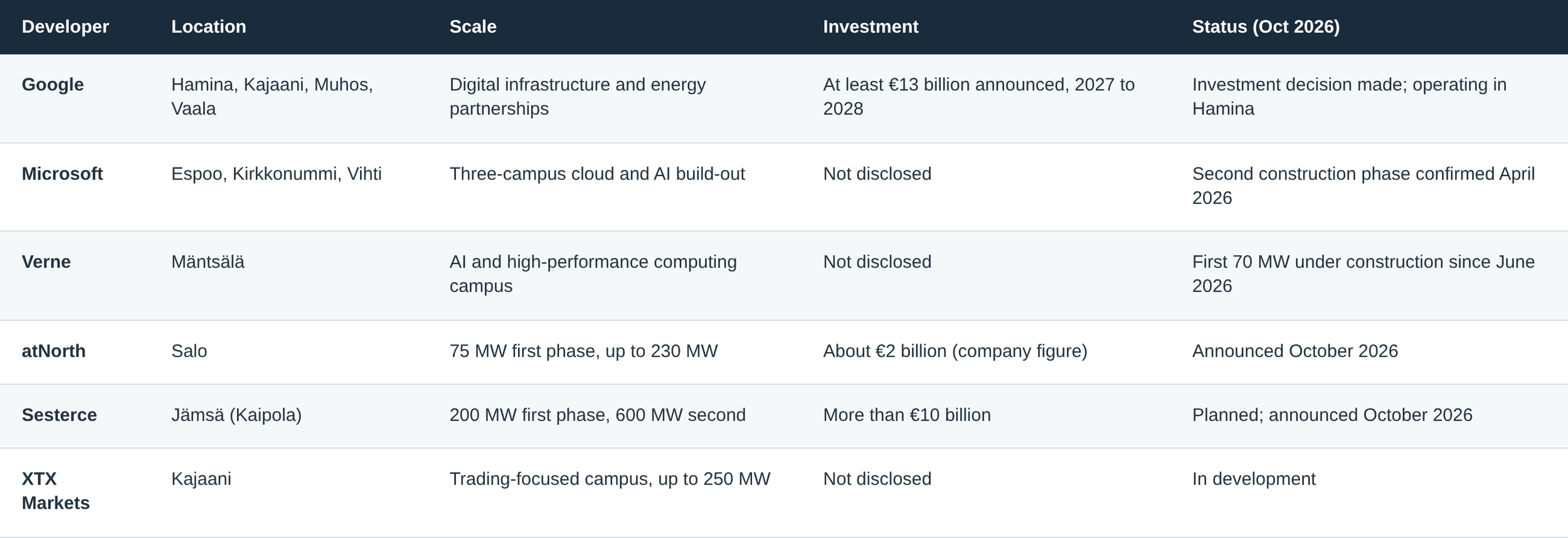
Table 1. Selected projects as of October 2026.
Projects move step by step from announcement through a grid connection agreement and a final investment decision (FID) to operation, and Fingrid expects growth on that scale to take at least five years. Interest is also spreading geographically: Northern Finland, inland sites and the Helsinki region all feature in the pipeline.

Why operators choose Finland
No single factor explains the interest. Several reinforce one another.
Low-carbon electricity
Finland's 2025 electricity mix was 39.6 percent nuclear, 27.9 percent wind and 15.6 percent hydro. For operators, that makes it easier to cut the emissions of energy-intensive computing and to report them under frameworks such as the EU's Corporate Sustainability Reporting Directive (CSRD). Google's Finnish plans reflect it: a 22-year agreement linked to the Loviisa nuclear plant and a 94 megawatt (MW) battery system sit alongside the data center investment.
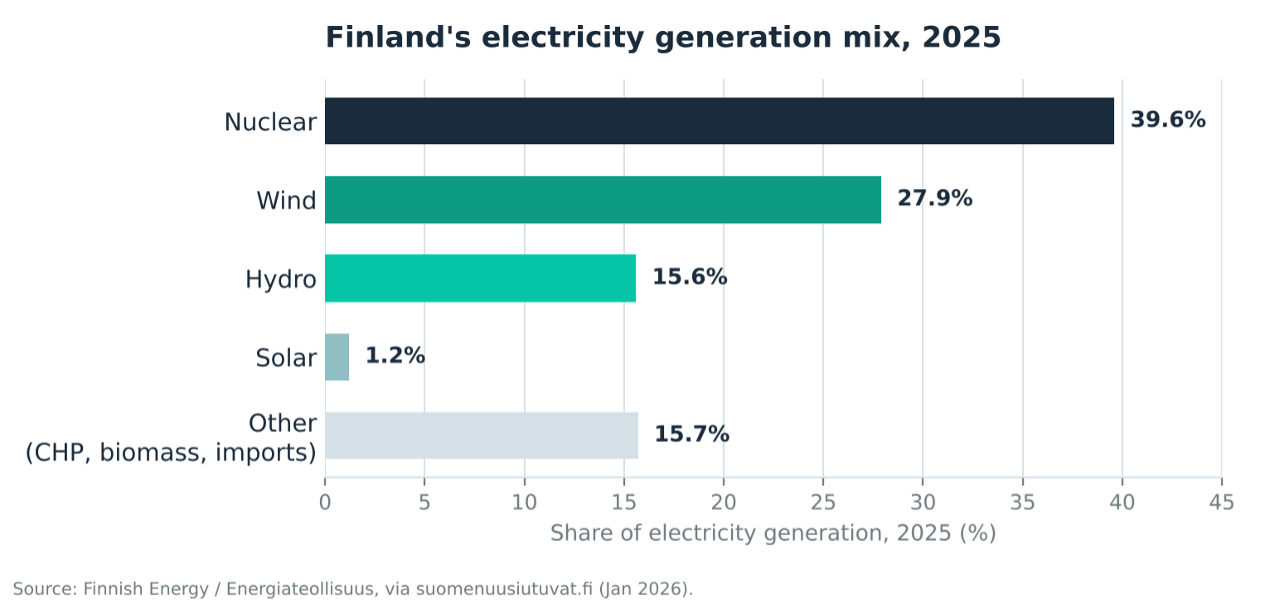
Figure 1. Finland's electricity generation mix, 2025. "Other" is a residual (CHP, biomass, imports).
A climate that helps cooling
Cool outdoor temperatures let operators reject heat to the air for much of the year. That reduces the energy spent on mechanical refrigeration and shows up in the efficiency metric power usage effectiveness (PUE), the ratio of total facility energy to the energy used by IT equipment.
Connectivity, infrastructure and stability
The C-Lion1 submarine cable, built by the Finnish company Cinia, links Helsinki and Rostock in Germany over 1,200 kilometers and carries up to 144 terabits per second. Cinia says it makes Helsinki appear "as a suburb of Frankfurt." Behind it sit an established industrial electricity system, engineering expertise and a predictable legal environment, which count when capital is committed to assets that will operate for decades.
Heat reuse is the fifth factor and gets its own section below. None of this settles a project alone: returns still hinge on the site, the grid connection, the tenants, the cooling design and how the facility is run.
Power: the opportunity and the challenge
Deliverable power, not land, is now the scarce resource. Fingrid's August assessment counted nearly 5 GW of planned data center capacity under signed connection agreements, alongside more than 3 GW of electric boilers either operating or being built and over 4 GW of battery storage agreements. It also called for more weather-independent balancing power.
A Fingrid study from September shows the geographic gap: more than 70 percent of generation sits on the west coast and in the north, while over half of consumption is in the south. Placing new connections closer to generation, it concludes, could raise the transmission grid's connection capacity by as much as 20 GW. For developers, site selection is becoming a grid decision as much as a real estate one.
Grid rules are evolving alongside demand. Finland is preparing clearer principles for prioritizing connection requests, and a new grid code, KJV2026, will ask large consuming facilities to support grid stability, for example by riding through disturbances and adjusting their power intake. For well-prepared projects this offers a clear and predictable framework.
Flexibility is becoming part of the picture too. Data centers are increasingly discussed not only as large consumers but as active participants in the power system. Telia's Helsinki data center has supplied several megawatts of fast frequency reserve to Fingrid's market with its uninterruptible power supply (UPS) batteries since 2021, and Fingrid sees value in involving data centers in demand-side flexibility as wind power grows.
The discussion is now widening to on-site batteries, reserve capacity and generation that could support the grid when the system asks for it, alongside their primary role of securing the facility's own uptime.
On cost, the lower electricity tax class for data centers ended on 1 July 2026. They now pay the general rate of 2.24 cents per kilowatt-hour (kWh) instead of 0.05 cents. In September the government dropped the planned replacement support, saying the country's appeal does not rest on tax aid. Operators now plan on the general rate.
Heat: from waste to product
Almost all the electricity a computing facility draws leaves it as heat. In most countries that heat is a disposal problem. Finland's district heating networks make it a potential product.
The Fortum and Microsoft case shows both the promise and the sequence. Fortum reported in May 2026 that its heat pump plants at Kolabacken (Kirkkonummi) and Hepokorpi (Espoo) are running, for now on outdoor-air heat pumps and electric boilers. Waste heat from Microsoft's two sites is to be brought in gradually from 2027, following the construction schedule, and is meant to supply about 40 percent of the area's yearly heat demand of roughly 2 terawatt-hours (TWh). In Helsinki, Helen signed an agreement with OnZero on 31 August 2026 to recover more than 500 gigawatt-hours (GWh) of heat a year from a data center that is still at the planning stage, with recovery to start in 2027.
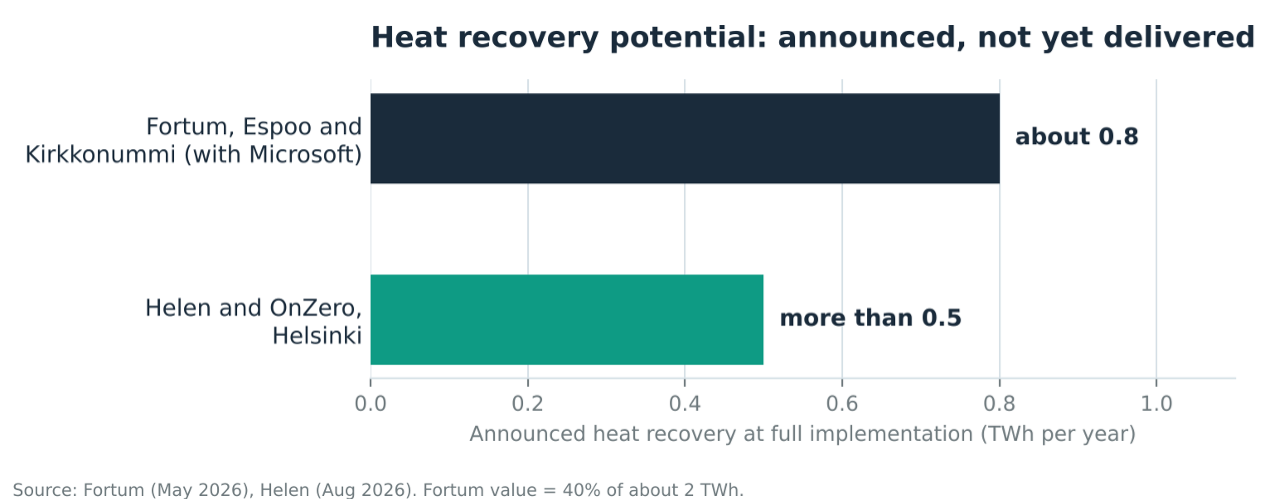
Figure 2. Announced full-scale heat recovery per year, not current delivery.
Reuse comes with conditions: matching temperatures, heat pumps, nearby customers with seasonal demand, and a commercial deal that works for both sides. Several newer projects, including Sesterce's Jämsä campus, are looking at heat reuse as part of their plans.
Cooling and water: an advantage with conditions
Water use has become a central question in data center permitting worldwide. Evaporative cooling is efficient in warm climates but can consume large volumes, whereas Finland's climate favors dry and free cooling for much of the year, which moves heat to the air without evaporating water.
Liquid cooling does not by itself mean high water use. Direct-to-chip systems keep water or water-glycol mixtures in closed circuits, and the footprint depends on how the heat is finally rejected. Sesterce describes closed-loop cooling topped up with collected rainwater and reused water. As rack densities rise, these distinctions will matter more, and a cold winter alone will not keep a facility efficient: heat exchangers, pumps, fluids and filtration must stay in good condition for several decades.
Finland in a Nordic context
Sweden, Norway and Denmark chase the same demand with different advantages. Industry tracking of corporate PPAs in the IT sector puts Finland and Sweden close together at about 1 GW each, ahead of Denmark and Norway. Sweden pairs a cool climate with tax relief for efficient facilities, and Norway offers a nearly all-hydro grid with its own incentives. The balance shifts as policies and grid conditions change.
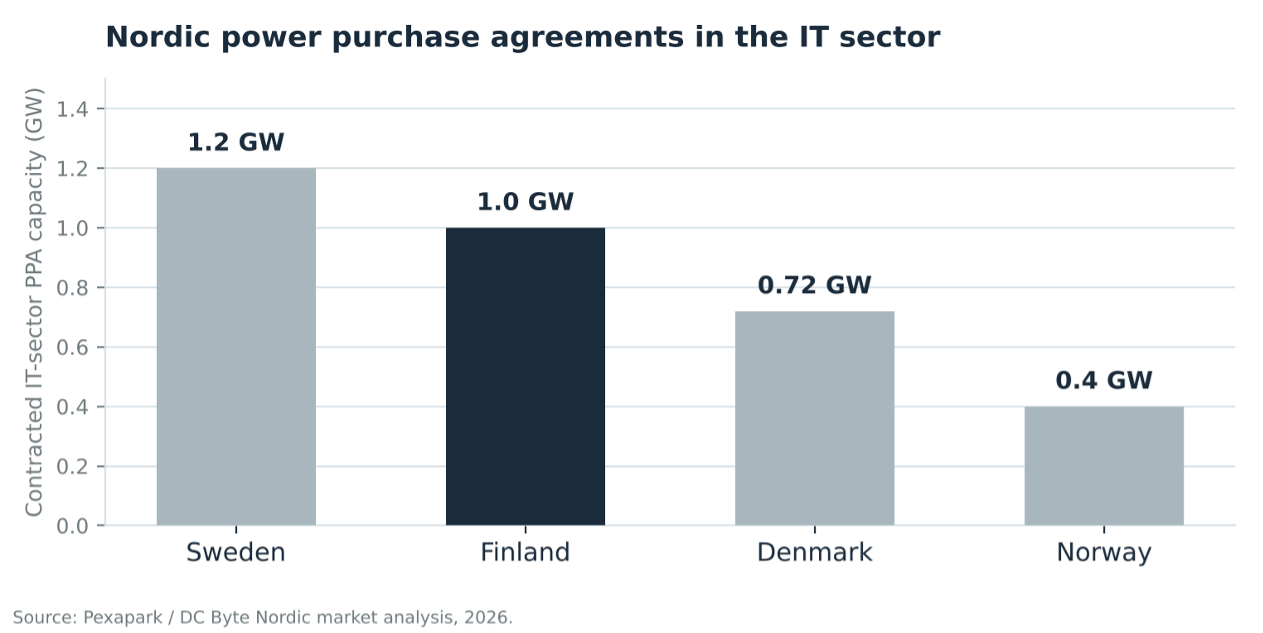
Figure 3. Contracted power purchase agreement (PPA) capacity in the IT sector, by Nordic country. Contracted PPA capacity, not installed data center capacity.
What it takes to deliver
For anyone planning a facility in Finland, delivery comes down to three practical things: power, permits and local fit.
Power. Generation, transmission and flexibility need to keep pace with new demand, and sites that bring flexibility of their own are well placed.
Permitting. Permitting takes time. Doing it thoroughly and by the book from the start is the surest way to keep large projects on schedule.
Local fit. Construction brings many jobs, while permanent staffing is smaller. Lasting value comes from tax income, heat delivery, supplier networks and skills built around the site.
Operational excellence starts with critical fluids
Today's discussion is about announcements, connections and construction schedules. The facilities behind them will run for several decades, and their competitiveness will depend on operational excellence. Critical fluids are one of the factors that most shape this reliability. They run through three domains: grid power, liquid cooling and back-up power.
Grid power. Transformer insulating oil and the lubricating oil of synchronous condensers carry early evidence of developing faults in the grid connection.
Liquid cooling. Coolants and water loops make cleanliness, chemistry and contamination control design parameters, particularly in AI halls. Where a site delivers heat to a district network, stable flow and return temperatures make the condition of the loop part of the commercial promise.
Back-up power. Fuel, engine oil and coolant decide readiness when the system needs it. If back-up and on-site assets also support the grid and run more often, their condition matters even more.
Fluids should be changed when their condition calls for it, not when the calendar says so. Much of their lifetime value is also decided early, in design, construction and commissioning. The wider view is set out in Fluid Lifecycle Management for AI Data Centers.
What happens next
Over the next few years the market will show what share of the announced pipeline becomes operating capacity. Four things are worth following: proposals turning into final commitments, grid expansion and connection rules, the economics of heat recovery once Fortum and Helen begin deliveries in 2027, and the growth of an ecosystem able to serve these sites for decades.
Finland has a strong chance to be more than a great location. With a clean energy system, an industrial engineering heritage and growing experience from real projects, it can become a recognized center for AI data center technology, operational excellence and optimization, from grid connection and heat reuse to cooling and back-up power. That is why Finland is worth following closely and visiting: the projects, partnerships and operating models taking shape here will become reference cases for others. We will return to the topic in further articles.
About Fluid Intelligence
Fluid Intelligence is a Finnish technology and professional services company providing Fluid Lifecycle Intelligence services for critical industrial fluids. For over a decade it has worked with critical fluids in energy production, heavy industry and grid infrastructure. It works alongside investors, developers, engineering firms, equipment manufacturers, utilities and operators. For AI data centers it supports projects from design, construction and commissioning to operation, where lifetime optimization of fluids and assets is the longest phase. With Fluid Eye®, all of it comes together in one Fluid Lifecycle Intelligence view.
Related solutions from Fluid Intelligence
Fluid Eye® for Data Centers — fluid lifecycle intelligence across power grid, cooling and backup power systems.
Transformer Oil Analysis — DGA interpretation, parameters and sampling guide for grid-connection assets.
Connected Oil® Real-Time Monitoring — continuous condition monitoring for critical fluid systems.
Fuel Optimization — fuel polishing, water removal and contamination control for backup power.
Reporting & Documentation — audit-ready fluid data for Scope 1 to 3 and lifecycle reporting.
Next steps
Fluid Lifecycle Management for AI Data Centers →
Power Transformer Lifecycle Management: Commissioning, Oil Monitoring and Performance Optimization →
How Fluids Are Becoming Mission-Critical in Data Centers →
How Oil Analysis Improves Equipment Reliability →
Ready to see where your facility stands?
Talk to an expert about fluid lifecycle management for your data center, at design stage or in operation.