
What Is Fluid Lifecycle Management for AI Data Centers?
And Why Cooling, Grid Power and Backup Fuel Are One Reliability Problem
Fluid lifecycle management is the practice of monitoring, optimizing and extending the working life of every mission-critical fluid in a facility, from liquid coolant to transformer oil to backup generator fuel, as one connected system rather than three separate maintenance schedules.
In an AI data center, that system spans nine distinct fluids across three domains: grid electricity, liquid cooling and backup power. Most facilities manage them separately, through different suppliers on different schedules. Few manage them as one, which is exactly where the largest reliability, cost and sustainability gains are still unclaimed.
This article sets out what that system looks like, why it has become a strategic reliability question rather than a maintenance one, and where fluid condition is often the only lever still open for cost and sustainability gains.
This is the short version. The full picture, including all nine fluid systems and the data behind every chart here, is in our white paper: The AI Data Center Fluid Imperative.
A data center is also a fluid system
A data center is commissioned and financed as an electrical and computing asset. Operationally, it is also a substantial industrial fluid system. Coolant circulates through cold plates or immersion tanks. Insulating oil protects the transformers at the grid connection. Fuel sits in storage for the moment the grid fails, alongside the lubricants and coolant inside the generator sets themselves.
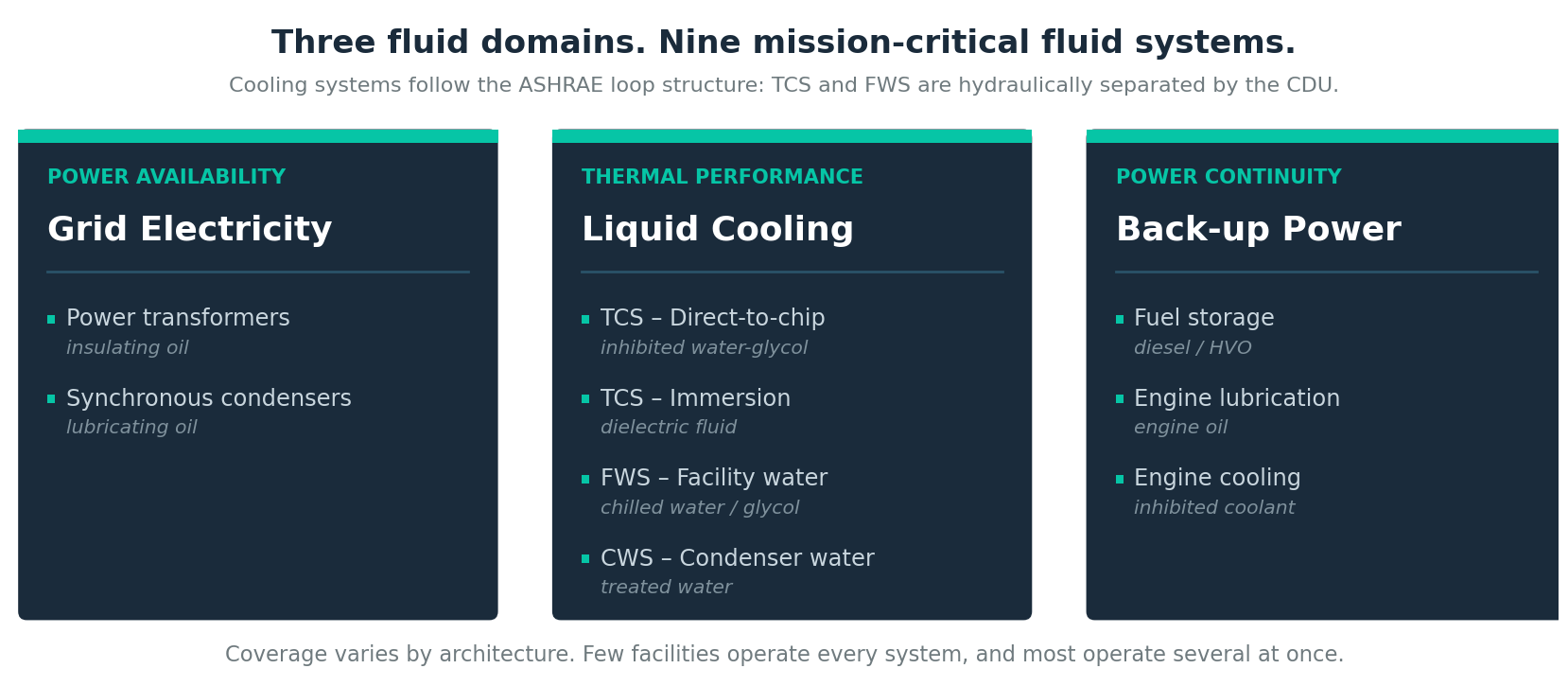
The three fluid domains in an AI data center, and the nine systems within them. Coverage varies by architecture.
Each of these nine systems has its own chemistry, its own failure mode and, usually, its own supplier. That is precisely why they end up managed as separate line items instead of one lifecycle. Volume is not a reliable guide to which one matters most. A cold plate channel, a fuel filter or an engine bearing has very little tolerance and no reserve, so the smallest systems on site often carry the shortest path to a stoppage.
Why this has become a reliability issue
Two things have changed the calculus. First, equipment lead times for transformers, switchgear and generators now run into years in many markets, so an asset that cannot be replaced on demand also cannot be run to failure. The priority shifts to lifecycle management: extending its working life for as long as possible. Second, fluid is an asset itself, and it is the one that gives warning first. Its condition is the leading indicator; temperature, pressure and flow are lagging ones, and they only move once a problem is already well underway. By then, the best window to fix it cheaply, measured in weeks or months, has usually already closed.
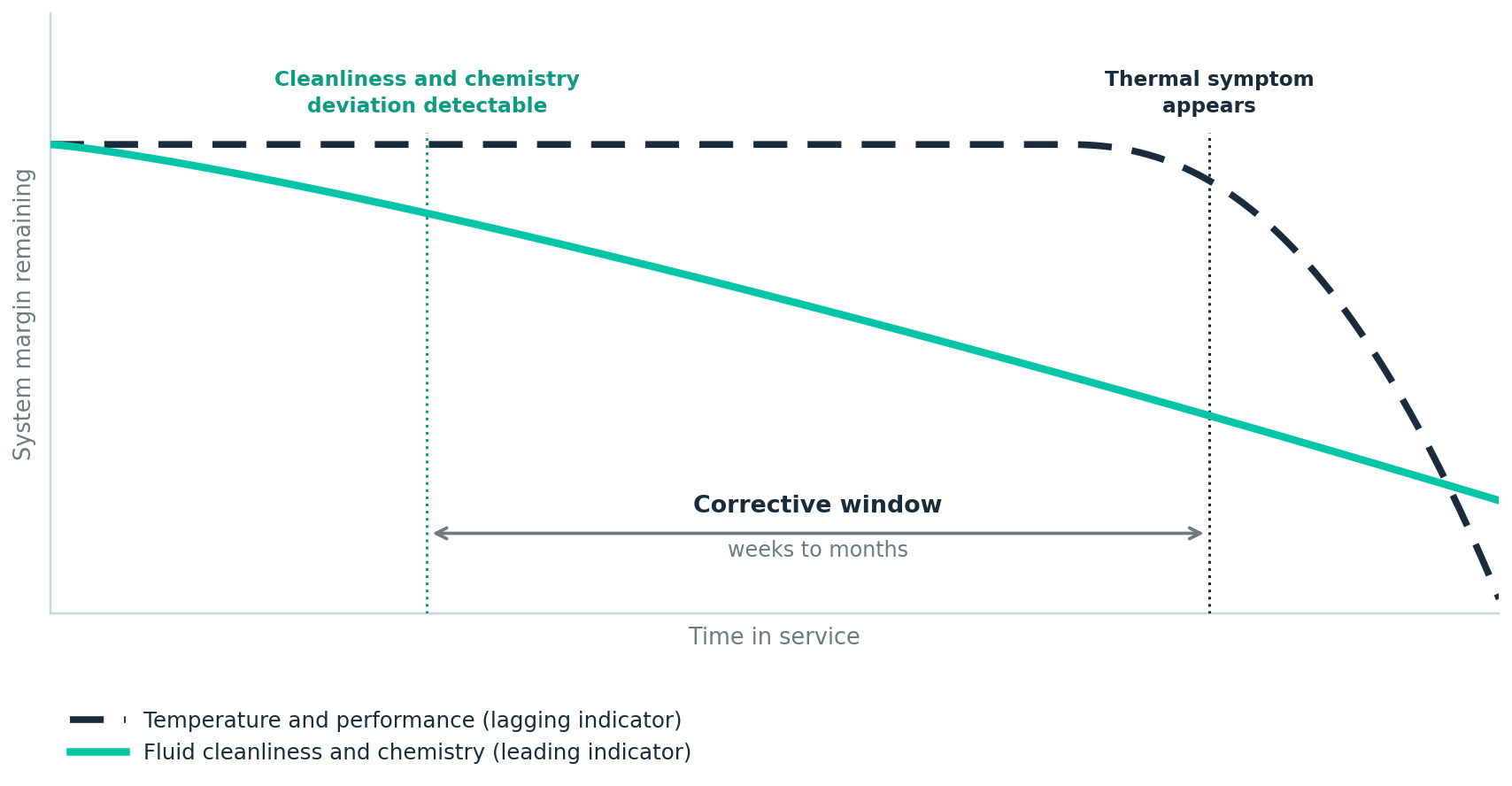
Fluid condition deviates well before thermal or performance symptoms appear, leaving a corrective window measured in weeks or months.
The three domains are also connected in ways that a single maintenance contract rarely captures. A degraded cooling loop raises thermal stress on the equipment around it. A grid disturbance shifts full load onto backup generators whose readiness depends on fuel, lubricant and coolant condition, all at once. Redundancy protects well against independent failures. It protects far less well against fluids that are quietly correlated.
The cost asymmetry
More than half of operators report their most recent major outage cost over USD 100,000, and one in five put it past a million. Programme cost naturally varies with the size of the site, but it sits in the hundreds of thousands of dollars a year for a facility of meaningful scale, not the millions those outages can reach one time in five.
The second half of the case is fluid life itself. Condition-based management routinely at least doubles usable fluid life compared with fixed replacement intervals, which cuts the recurring spend on top of the reliability upside. Even generous assumptions on both sides point the same way: the programme costs a fraction of what one avoided incident is worth.
Field result — Vatajankoski Power, back-up power engine
A GE Jenbacher gas engine used for grid back-up power moved from calendar-based oil sampling to real-time performance monitoring with Fluid Eye®. The result: oil lifetime extended threefold, operating costs down 30%, and zero downtime events. A similar engine type, and comparable back-up duty, sits behind many AI data center power continuity systems.

Sustainability: the lever that is still open
Environmental reporting is expanding fast, and the direction is consistent: from energy alone toward water, waste and equipment lifecycle. Power usage effectiveness (PUE) and water usage effectiveness (WUE) are already standard. Energy reuse factor (ERF) and renewable energy factor (REF) are close behind, and in the EU the Corporate Sustainability Reporting Directive (CSRD) is pushing Scope 1 to 3 emissions data toward the same level of scrutiny. Fluids sit inside all of these categories and are usually the least measured part of the picture.
Where a facility has already committed its waste heat to a district heating network, flow rates and return temperatures become fixed obligations rather than variables, which closes off the conventional levers for improving environmental performance. Fluid condition remains addressable throughout, because it depends on how a facility is run rather than how it was built. Done well, fluid lifecycle optimization can move several of these metrics at once: less fluid consumed, less waste generated, and a lower footprint across the facility's life.
How Fluid Eye® applies this to AI data centers
Fluid Eye® brings laboratory analysis, real-time condition monitoring, fluid optimization and compliance reporting into one operational view across all nine systems, rather than nine separate reports. Each of those carries through to the solutions below, and to the full technical breakdown, including degradation modes and monitoring parameters for every system, in our white paper.
THE AI DATA CENTER FLUID IMPERATIVE - Free white paper (21 pages)
The full analysis behind this article: all nine fluid systems in detail, the reliability and cost case with published benchmarks, the sustainability argument, and what this means for operators, investors, developers and OEMs across the value chain.
Related solutions from Fluid Intelligence
Fluid Eye® for Data Centers — fluid lifecycle intelligence across power grid, cooling and backup power systems.
Transformer Oil Analysis — DGA interpretation, parameters and sampling guide for grid-connection assets.
Connected Oil® Real-Time Monitoring — continuous condition monitoring for critical fluid systems.
Fuel Optimization — fuel polishing, water removal and contamination control for backup power.
Reporting & Documentation — audit-ready fluid data for Scope 1 to 3 and lifecycle reporting.
Next steps
Power Transformer Lifecycle Management: Commissioning, Oil Monitoring and Performance Optimization →
How Fluids Are Becoming Mission-Critical in Data Centers →
How Oil Analysis Improves Equipment Reliability →
Ready to see where your facility stands?
Talk to an expert about fluid lifecycle management for your data center, at design stage or in operation.